
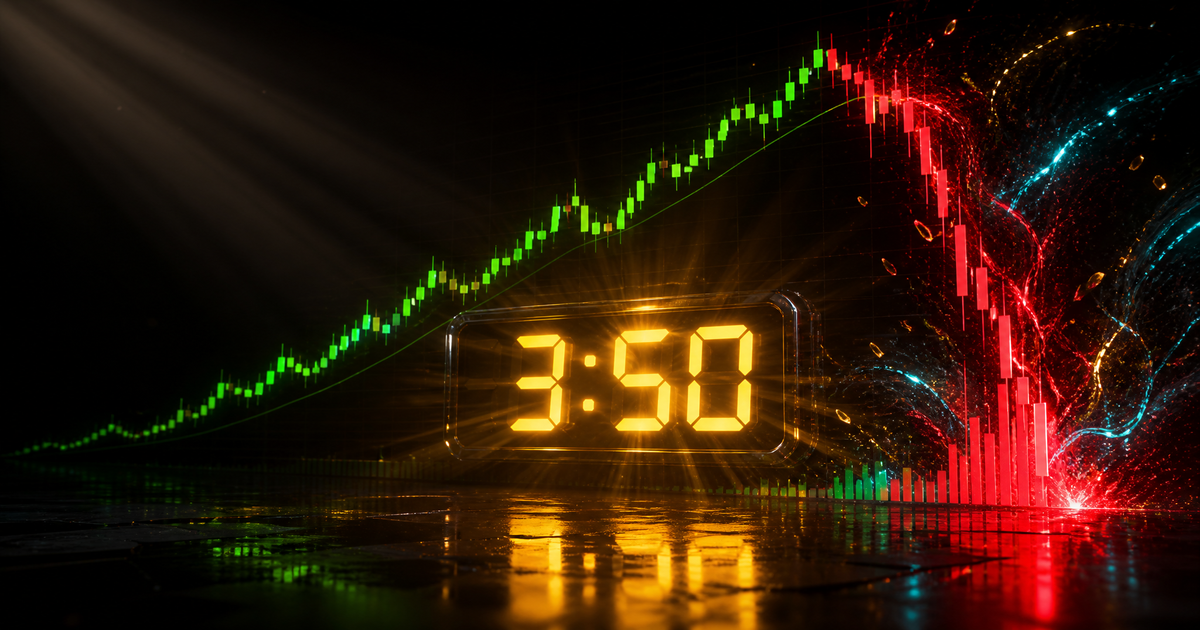
The Trade You Already Won
It is 3:45 PM ET. You called the day correctly. Your $5-wide 0DTE debit spread is sitting near full value. The hard part is over — SPX did exactly what you read it would do, and the day handed you the move.
Then you decide to hold “just a few more minutes” for the last bit of value. And in the final ten minutes, the tape turns on you. A green day becomes a red close. The gain you were holding evaporates before the bell.
This is the most avoidable loss in 0DTE trading, and it has almost nothing to do with your read of the market. It has to do with what happens at exactly 3:50 PM ET — when the New York Stock Exchange begins publishing the Closing Auction imbalance.
You do not lose the last ten minutes because you were wrong. You lose them because you stayed in a part of the day that is no longer trading on your read — it is trading on the auction.
What Happens At 3:50 PM ET
The last few minutes of the SPX cash session are not a continuation of the day. They are a separate event with its own rules: the Closing Auction. It exists so that index funds, ETFs, and institutions can execute enormous Market-On-Close (MOC) and Limit-On-Close (LOC) orders at one single official closing price.
At 3:50 PM ET, the NYSE starts publishing the Closing-Auction Imbalance — a live feed showing how many shares are stacked to buy versus sell at the close, and on which side the pressure sits. From that moment, algorithms across the market react to the imbalance in real time, updating and re-updating right into the bell.
3:50
PM ET — NYSE begins publishing the Closing-Auction Imbalance
10 min
The window where price stops tracking the day and starts tracking the auction
1 print
A single official closing price everyone is forced toward
Here is the key point most 0DTE traders never internalize: 0DTE options settle on the closing price, not on the high you saw at 3:45. Whatever the auction decides the close is, that is what your spread is worth. Your favourable excursion during the day is irrelevant to settlement.
Why The Closing Auction Is Pure Chaos
Once the imbalance is public, the final minutes become the single most concentrated, least predictable stretch of the entire session. Three things happen at once:
- Volume explodes. The Closing Auction is routinely one of the highest-volume moments of the whole day — a huge share of daily volume prints in these last minutes. Liquidity that behaved all afternoon suddenly gets steamrolled.
- Price gets dragged, not discovered. If there is a large buy imbalance, price is pulled up into the bell; a large sell imbalance drags it down. This is mechanical order-matching, not a fresh opinion about value.
- Algorithms pile on. Arbitrage and rebalancing desks trade against the published imbalance, amplifying the swing until the auction clears.
A calm, orderly Trend Day can post its most violent move of the session after 3:50 PM — in the exact window where your read of the day no longer applies. You are no longer trading the market you analyzed. You are standing in front of an order-matching engine.
The Reversal Is Not Bad Luck — It Is Structural
The cruelest part is that much of the closing-auction move is temporary. Market-microstructure research on closing auctions finds that a large portion of the price impact created by the auction reverses — partly the next morning, and partly over the following few sessions — as the mechanical pressure unwinds.
In plain terms: the spike into the close is often the auction absorbing a pile of forced orders, not the market repricing SPX. But you do not get to wait for the reversal. Your 0DTE contract settles at the distorted print. The temporary move is permanent for you.
| What you think you have | What the auction can do |
|---|---|
| A winning spread at 3:45 | A settlement print ten points away |
| A clean Trend Day | A violent final-minute reversal |
| “Just a little more value” | A full round-trip of the day’s gain |
| Your read of the market | Mechanical order-matching you cannot forecast |
You cannot analyze your way through the Closing Auction. Nobody publishes the full imbalance early enough for a retail 0DTE trader to reliably position for it — and even the institutions trading it are hedging flow, not predicting direction. The only edge available to you is not being there.
0DTE Makes It Worse, Not Better
0DTE options are the most sensitive instruments in the market to exactly this window. Two forces compound:
- Gamma peaks into the close. As expiration approaches, dealer Gamma on same-day options concentrates around the current price. Small moves in SPX force outsized hedging, so the final hour — and especially the final minutes — is where price is most twitchy.
- There is no tomorrow for the contract. A longer-dated option can wait out a bad print. A 0DTE spread cannot. Whatever the auction stamps as the close is your final answer, with no recovery session.
SPX now carries a very large share of its daily option volume in same-day expirations. That means a growing wall of contracts is settling on a single auction print that the trader has no control over — and the last place a small account wants to be is holding a defined-risk winner into the most reflexive ten minutes of the day.
The One Rule That Protects A Winning Day
The discipline is simple, and it is not a prediction. It is a boundary:
Be flat before 3:50 PM ET.
If your 0DTE debit spread is at or near your target, close it before the NYSE begins publishing the Closing-Auction Imbalance. Take the profit the day handed you. Do not donate the last ten minutes to an order-matching engine.
Notice what this rule is not. It is not “get out at a loss because you are scared.” It is the opposite — it is how you keep a gain you already earned. You did the hard part when you read the day correctly. Protecting that read means refusing to re-risk it in the one window where your read stops mattering.
- If you are up near your target by mid-afternoon — take it. There is no medal for holding to the bell.
- Set a hard time stop at ~3:45–3:50 PM ET, not just a price stop. Time is the risk here, not level.
- Never add to, or open, a fresh directional 0DTE position inside the closing window hoping to “catch the auction.” That is not a trade, it is a coin flip against algorithms.
Getting the direction right is the skill. Getting out with the profit is the discipline. The Closing Auction is where undisciplined winners turn back into losers.
How SPXXL Already Engineers Around It
I take this so seriously that it is built into how the Engine reads the day. When SPXXL classifies a Session and grades its outcome, it excludes the final minutes before the close — the Auction Window — from the classification math.
Why? Because if I let the closing-auction surge into the Session Classification, a clean Trend Day would get mislabeled by a mechanical spike that was never part of the day’s real character. By cutting the Auction Window out of the analytical read, the Engine describes the tradeable day — the one you can actually act on — not the distortion that happens after you should already be flat.
The same logic that makes my classification honest is the logic you should trade by: the real day ends before the auction begins. Read the day, take your trade, and be out before 3:50 PM ET.
Take The Profit The Day Handed You
SPXXL exists to help you read one clean SPX day at a time — what kind of Session it is, where it is likely to go, and a defined-risk debit structure to express it. The house rule is deliberately small: a hard ceiling of $400 per trade and a minimum of $100 of profit potential. One clean trade, taken and closed on discipline — not held into the chaos.
The market opens again tomorrow, and a new Session gets classified before the bell. You do not need to squeeze the last ten minutes out of today. You need to be there tomorrow with your account intact.
Five full trading days of Elite access. No cost. Nothing to cancel. SPXXL is an educational analytics tool — it does not predict or guarantee any trading outcome, and you are always responsible for your own risk.