
Know What Kind of SPX Day It Is — So You Trade the Right 0DTE Structure. Not a Guess, an EDGE.
Right on direction. Still red at the close. I built SPXXL so I'd stop losing on the days I read wrong — and so you can too.
SPXXL reads the live tape, scores it across 7 dimensions, and gives you the right 0DTE structure for today's session (Call, Put, Butterfly, or Condor) — before you place a single trade.
Already have an account? Sign in →
Know Exactly What to Trade — in 3 Simple Steps
No indicators to configure. No guesswork. Log in and today's session is already classified, scored, and matched to a structure — before the bell.
Log In & See Today’s Session
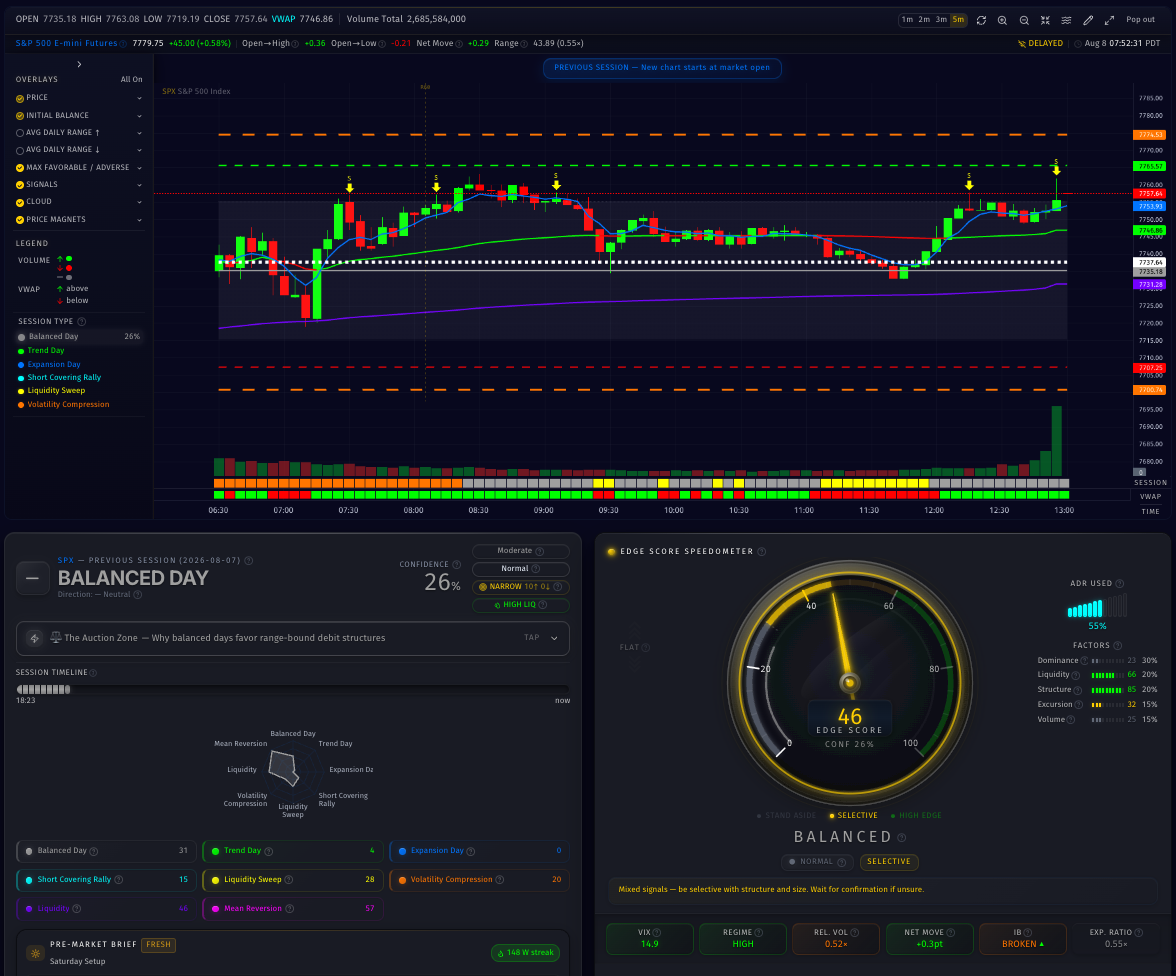
The moment you open SPXXL, it reads the live SPX tape and classifies the day across 6 session archetypes — each scored 0-100 with a confidence %. Nothing to install, nothing to set up.
Read the Edge Score
One glance tells you the regime, confidence, and whether today favors trend, reversion, or range. The dual-panel chart maps VWAP, IB, and ADR levels so you see exactly why.
Trade the Right Structure
SPXXL hands you the 0DTE structure that fits today’s session — Directional Call/Put, Condor, or Butterfly — so you place the setup with the edge instead of guessing.
6
Session Archetypes
7
Scoring Dimensions
30s
Live Refresh
2
Chart Panels
They Stopped Guessing the Session — And Started Trading With the Edge
These traders replaced gut feeling with a scored classification — and their results changed.
I was guessing at structure selection every morning — Condors when I should have been doing Spreads. SPXXL tells me the session type within the first 30 minutes. My win rate on 0DTE went from 42% to 68% in two months.
Michael T.
0DTE SPX Trader · 3 years
The dual-panel chart is phenomenal. Lower histogram tells me the regime, upper chart gives me the levels. I finally stopped fighting Trend Days with range structures. The scoring engine is the edge I didn’t know I needed.
Sarah K.
Full-time Options Trader
After the PDT rule change, I needed a system to keep me disciplined. SPXXL’s session classification replaced my gut feeling with data. The confidence score alone saves me from low-probability setups.
David R.
Swing & 0DTE Trader
Why I Built SPXXL
Every trader has been the person who was right about the market and still lost money. This is the tool I built so I could stop being that person — and so you can too.
Right on direction. Still red at the close.
I spent years being right about where the market was going and losing money anyway — because I read the candle instead of the day. A Trend Day and a Balanced Day look identical at 9:31. The wrong structure on the wrong day is a loss, no matter how good your entry is.
The enemy was never the market. It was walking in blind.
You can't trade the day if you can't name the day. The real enemy is UNCERTAINTY — the fog of not knowing which of the six kinds of day you've walked into before you commit a dollar of premium. Everything I built exists to shrink that fog.
Name the day first. Then pick the structure that survives it.
I spent 10+ years learning to name the day before the bell, then built the instrument that does it — and grades itself in public, every session, including the days I get wrong. Now I read the day, not the candle, and match the structure to it.
Every trader has been the person who was right about the market and still lost money — because they read the candle instead of the day. I spent 10+ years learning to name the day before the bell, and I built the instrument that does it in public, graded every session, so you don't have to walk in blind.
The market opens tomorrow as one of six kinds of day. My job is to help you know which one before you risk a dollar — and to show you the days I got wrong right alongside the ones I got right.
Most 0DTE Traders Lose Because They're Playing the Wrong Structure for the Day
Every morning the market picks a session archetype. You either know which one and match the right structure — or you guess and get run over.
Your Current Reality
Trading without classification
- Guessing the session type after the bell rings
- Same spreads every day — regardless of regime
- Watching P&L swing with no structural edge
- News-driven decisions, not data-driven ones
- No grading system — no way to know if your read was right
Average 0DTE trader:No structural edge. Inconsistent results.
Your Future Reality
Trading with SPXXL classification
- Pre-market classification — before the open
- Structure matched to the day's archetype
- 7-dimension scoring engine backing every call
- 340+ graded sessions proving the edge
- Every session graded — process you can compound
SPXXL classified traders:Structured edge. Graded process. Daily clarity.
Stop Deploying the Same Structure on Every Session Type
Condors on a Trend Day. Directional plays on a Balanced Day. The session changes — your structure should change with it.
Without SPXXL
You traded range-bound structures — it's a Trend Day — max loss
You bought directional — it's a Balanced Day — theta eats you alive
You catch a Liquidity Sweep — panic exit — price reverses without you
You size up on an Expansion Day — it was Volatility Compression — range stays tight
You trade every day the same way — some days profit, most don't
With SPXXL
Dashboard reads "Trend Day, 87% confidence" — you deploy Debit Spreads
"Balanced Day" classification — you trade Debit Condors for the range
Liquidity Sweep detected — you wait for the reversal, deploy mean reversion
"Volatility Compression" flagged — you structure a Debit Butterfly or set breakout alerts
Every day, the structure matches the regime — consistency compounds
Everything You Need to Trade the Right Structure — Nothing You Don't
One dashboard. Live session classification, scored edge, projected close zone, and the levels that matter — so you place every 0DTE structure with conviction.
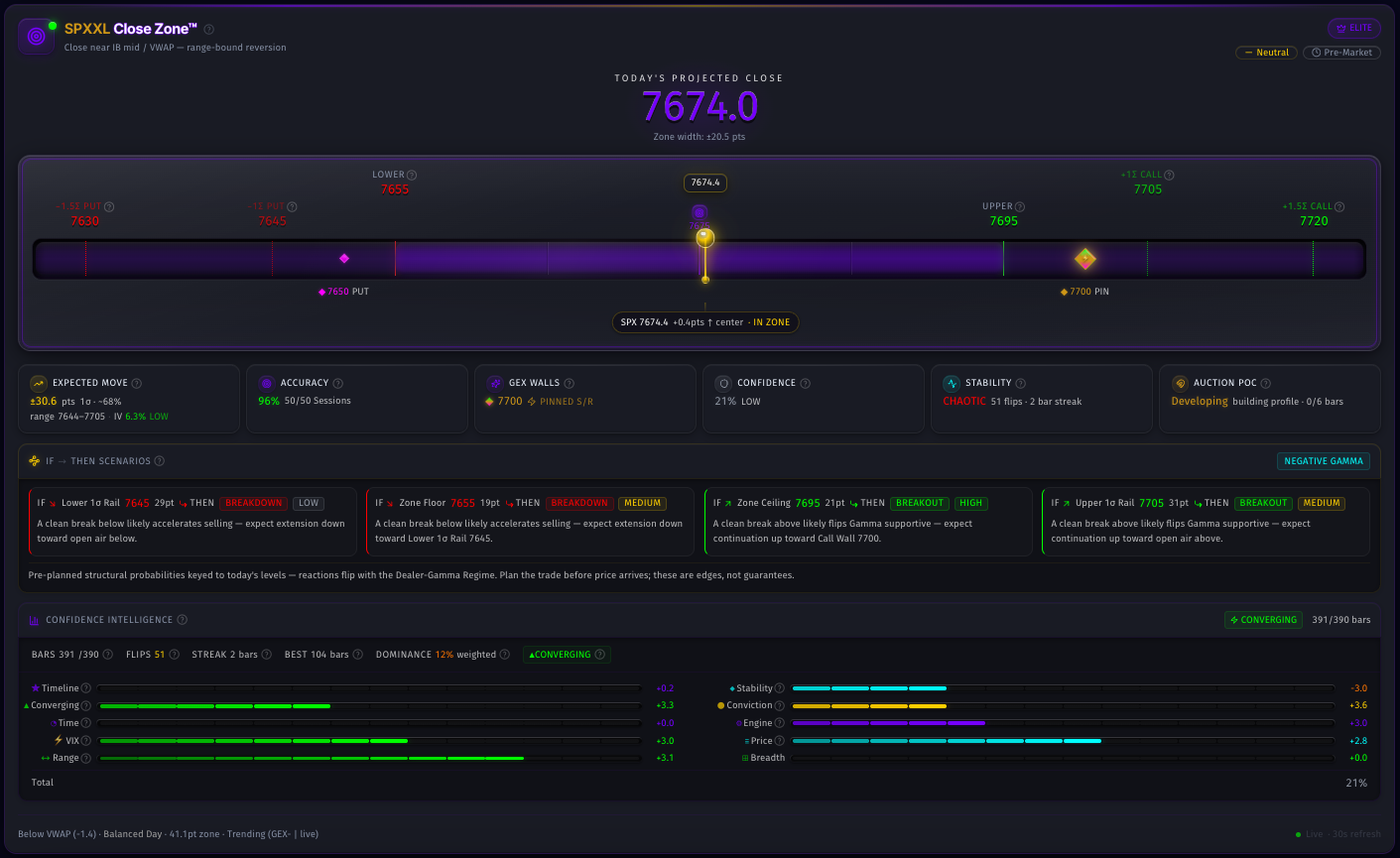
Know where SPX is likely to settle — before the bell
The Close Zone™ engine projects the day’s closing range with a live confidence gauge and gamma-exposure walls, so you can pick strikes with a defined target instead of guessing.
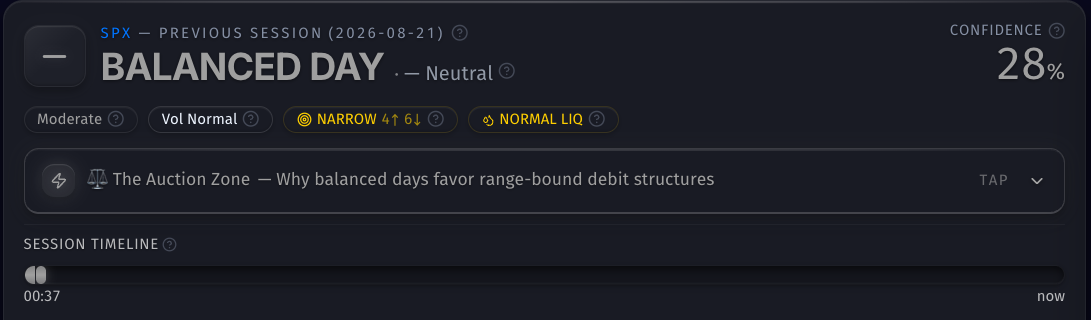
Match the structure to today’s session
Real-time classification across all six archetypes with a confidence read, so you stop forcing the same playbook onto every day.
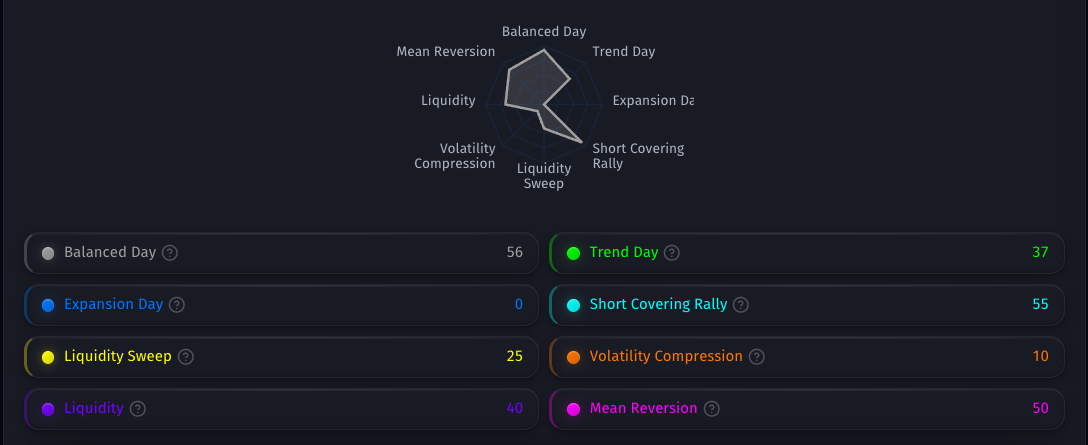
See the whole tape in one glance
Every session archetype is scored side by side — no black box, just an auditable read you can act on in seconds.
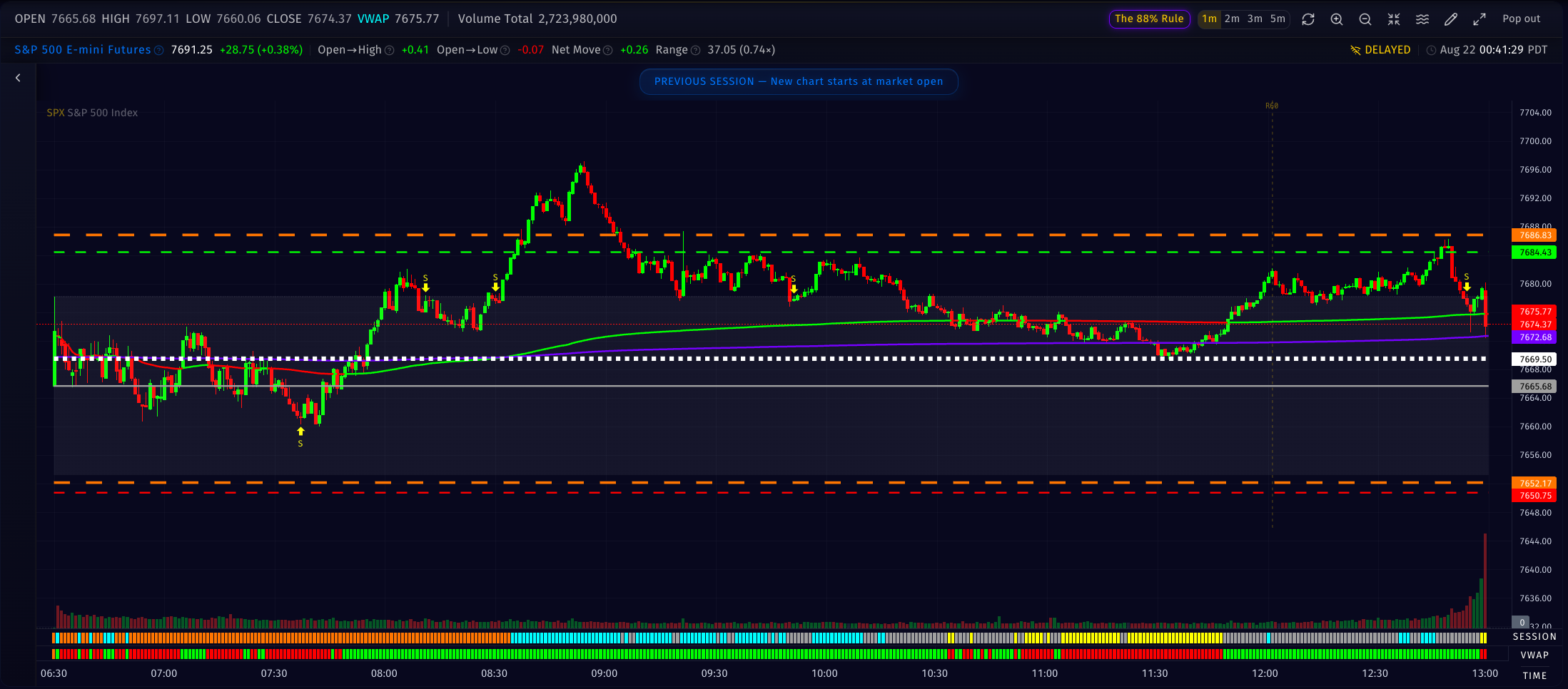
Your key levels, mapped before you trade
VWAP, Initial Balance, ADR extensions and excursion targets rendered on one interactive chart — so entries and exits are planned, not reactive.
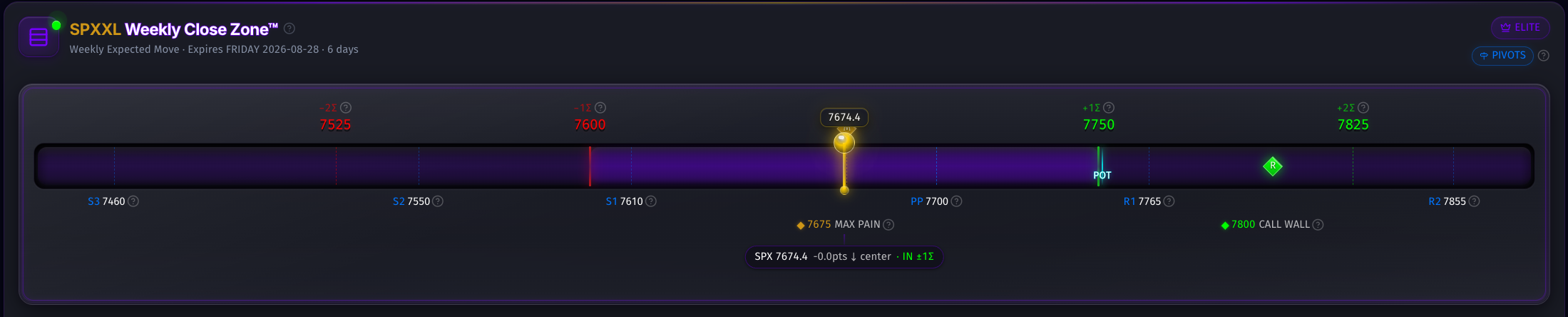
Plan the whole week, not just today
Weekly σ Bands, Put/Call Walls, ATM IV and Probability-of-Touch give you the bigger structure behind every daily move.
Learn the system, keep the edge
A 10-chapter reference walks you through all six archetypes, the scoring engine, the overlay system and a full scenario playbook — so the dashboard makes sense from day one.
Pricing
Start FREE — No Credit Card, Cancel Anytime
Try the full engine FREE for 5 trading days. If it doesn't change how you read the session, walk away — no charge, no commitment.
The Five-Dollar Edge
The $5 Trading Day
SPXXL Elite is $99 a month — about $4.95 a trading day. Five dollars to walk into every session knowing what kind of day it is, and which of the four 5-wide structures fits it. Less than you'll leave on the table with one rushed fill.
The honest math — a thought experiment, not a promise
I only teach 5-wide structures, and a 5-wide can be worth up to $500 at expiry ($5 × the ×100 multiplier). For a $5 day to be “worth it,” the read only has to have been worth about $5 to you — roughly one one-hundredth of a single structure's ceiling. I can't promise you'll clear that bar; nobody can, and 0DTE can lose the entire debit you pay. But that's the modest bar I'm asking five dollars to clear.
What the $5 a day actually buys
- Live session classification before the open — know the day’s archetype
- The 7-dimension Edge Score & structure-fit read
- Challenge Mode — the day’s qualifying 5-wide structures, pre-filtered
- The backtester, full session archive & deep-dives
- Real-time alerts + the trade journal
Five full trading days of Elite access. No card. Nothing to cancel.
The market opens again tomorrow, and a new session gets classified. That's the only clock.
Educational content only — not financial advice. 0DTE options carry substantial, rapid risk, including total loss of the debit paid. “$5 a day” describes the membership price, not a profit you will earn.
FREE Trial
5 live trading days with full Elite-level access — zero risk
No credit card · no commitment · starts instantly
- 5 full trading days of Elite access
- Real-time session classification
- Pre-Market Brief & confidence scores
- Complete dual-panel chart engine
- Full 7-dimension scoring engine
- No credit card required
0DTE 5-DAY PASS
Full dashboard + chart engine for 5 trading days — the perfect follow-up to your FREE trial
One-time purchase · 5 trading days from activation
- 5 full trading days of access
- Real-time session classification & alerts
- 7-dimension scoring engine (0–100)
- Complete dual-panel chart engine
- IB / ADR / VWAP levels on chart
- MFE / MAE excursion targets
- Liquidity Sweep & IB break signals
- Technical Reference Guide (PDF)
SPXXL ELITE
Unlimited access + backtester, history, API & more
- Everything in the 0DTE 5-DAY PASS, plus:
- Unlimited 24/7 access — no day limits
- Strategy Backtester — test any setup on 200+ sessions
- Historical session archive & deep-dive analysis
- Custom alerts & trade journal
- API access for programmatic data
- Priority support
Honest Answers
The questions you're actually thinking
SPXXL gives you a forward-looking classification system graded against 340+ real sessions with a proven edge. Every session is publicly graded — CORRECT, PARTIAL, or MISSED. No cherry-picking. No hiding the losses.
Check my public track record
That's not marketing — that's arithmetic. A single avoided -100% spread on a $500 risk trade is $500 saved. A $39 pass that prevents one wrong-direction trade has a 12:1 return.
And you don't need to start at $99/mo. Grab a $39 pass for 5 trading days and see the engine work in real-time first.
That's what the engine does in milliseconds. Every. Single. Session.
Your discretionary read is valuable — SPXXL doesn't replace it, it validates it. When you think it's a Trend Day and the engine agrees at 82% confidence, you trade with conviction. When it disagrees, you pause and re-evaluate. That's edge.
The engine also has a built-in Alpha Decay Monitor that tracks rolling 90-day accuracy by session type and alerts me if any archetype drifts more than 5%. I catch degradation before you feel it.
No tool is 100%. But a tool with public accountability, real-time grading, and self-monitoring drift detection is as honest as it gets in this industry.
If the engine doesn't change how you see the market in 5 sessions, you should leave. I don't want passive subscribers — I want traders who use the edge every day.
But here's what usually happens: by day 3, you'll check the dashboard before checking your charts. By day 5, you won't want to trade without knowing the session type first. That's not stickiness — that's signal.
Not Ready to Trade Yet? Learn the Session First
Get a free daily email after market close: today's session classification, confidence scores, and what the optimal structure would have been. No account required.
No spam. Unsubscribe anytime. Emails sent Mon–Fri after market close.