
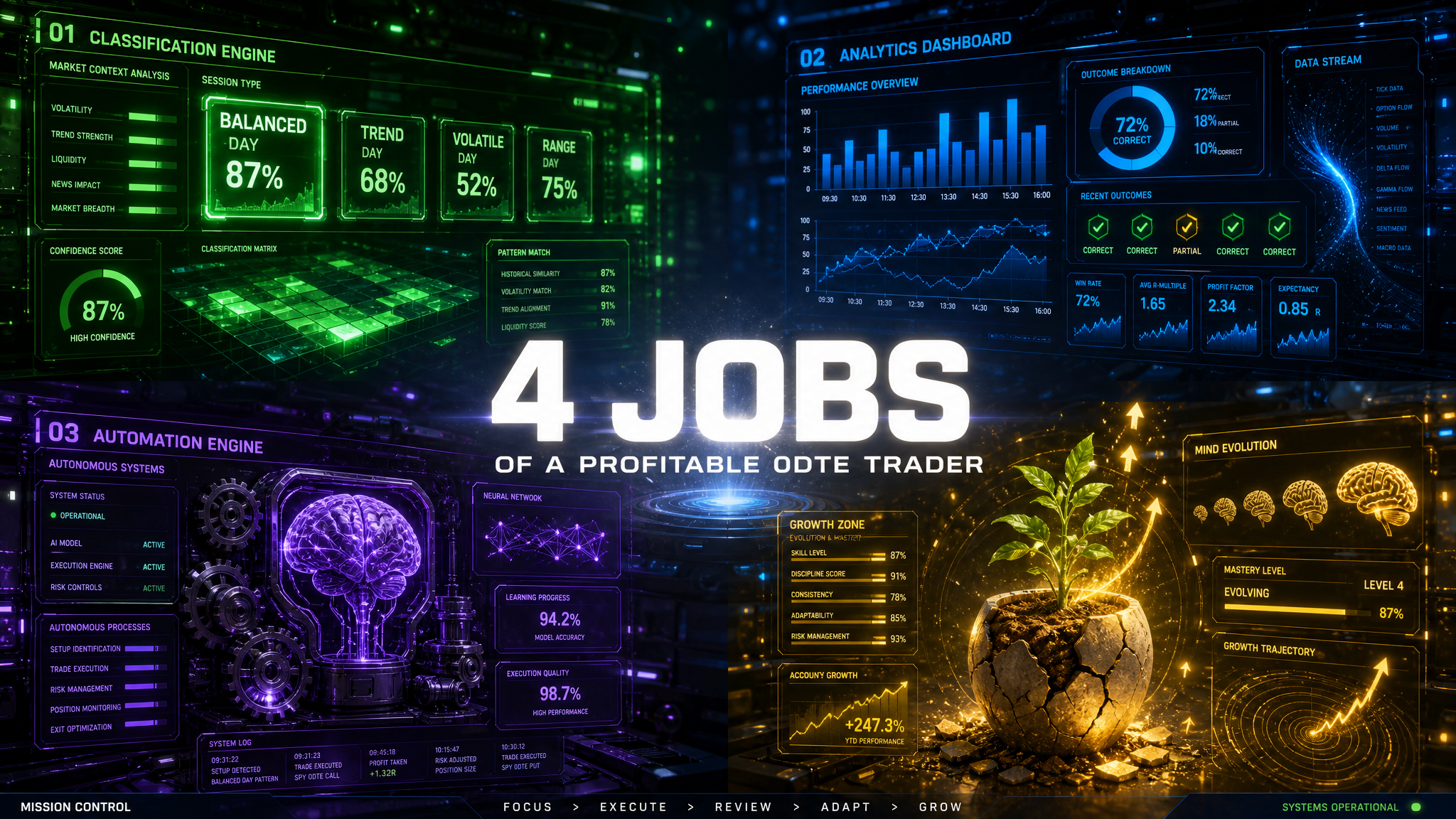
The 20-Job Trap: Why Most Traders Stay Stuck
Most traders are doing about 20 jobs at once. You're reading charts, scanning for setups, managing open positions, watching the VIX, checking the news, adjusting stop losses, calculating position size, monitoring your P&L, and somewhere beneath all of that, you're supposed to be making a calm, rational decision about whether to enter a trade.
So you trade all day, every day, and you still feel like when the bell rings you're behind. You're chasing your tail and never quite catching it.
But traders who actually grow their accounts — the ones who seem calm, the ones who seem to have it handled, the ones that look like they work less than you but earn more — they're not doing 20 jobs. They're doing just four.
The Core Problem
You're treating yourself like the most active employee in your trading business rather than the owner of it. The most expensive version of this — the one nobody notices — is treating execution like a task you'll get to when you have a spare minute after everything else, rather than the central function of your trading system.
If you hired someone to trade your system and found out they were spending half their time scrolling Twitter and rearranging chart layouts rather than executing the process you gave them, you'd have a word with them. "That's not your job. Focus on what I'm paying you to do."
It's no different for you. Your job as a trader is to build a system that identifies opportunity, executes with discipline, and does it all predictably. Anything that isn't moving you toward that is, by definition, not doing your job.
Build the Trading System (Stop Improvising)
Think about how most traders actually trade. They trade by ear. There's no written process — just improvising trade by trade, doing whatever feels right in the moment based on the last setup they saw. One day they're trading Debit Condors, the next they're buying Calls, the next they're sitting on their hands because they "don't like the tape."
It all sort of works most of the time, but it only works when you're the one doing it. The entire strategy lives in your head. A trading account where the process only exists inside your head isn't a system — it's a very tired and probably frustrated trader.
How SPXXL Handles Job 1
The goal is to build a system that any disciplined trader could follow without 10 years of screen time. Map out every step from session open to trade execution. When you do that, two things happen:
First, trading stops depending on your mood and your memory. It becomes immune to your emotions — whether you're feeling sharp or slow, confident or scared.
Second, the system becomes a process that can be followed consistently. You can't delegate a process that lives in your head. You need to get it systematized.
You're not the strategy. The system is the strategy. Get it out of your head.
Make It Measurable (Stop Guessing)
Imagine driving at night at high speed with no speedometer, no fuel gauge, no headlights. Sure, you know you're moving — the car's going forward — but you've got no idea how fast, how much fuel you've got left, or whether you're about to crash into something.
That's exactly how most traders run their trading. They're moving — taking trades, making some money, losing some money — but when you ask them: "What's your win rate by session type? What's your average excursion? Which structures actually work for you?" They can't tell you. They have a feeling about things, and that feeling changes depending on whether it's been a green week or a red one.
That right there is where the feast-and-famine cycle comes from. It's not bad luck. It's not the market. It's that you can't see what's working and what isn't, so you can't do anything about it until it's already too late.
How SPXXL Handles Job 2
The transformation is going from having a feeling about your results to having actual, actionable data in front of you. Every trader secretly wants this — the ability to sit down at the start of the week and actually know what's working instead of lying awake doing mental P&L math.
"You can't track a process if it's invisible." SPXXL makes the invisible visible — every session scored, every outcome graded, every pattern measurable.
Build the Team (Stop Being the Bottleneck)
Now that you've got a system and you can see it working, the next question is: who's running it?
Think how limiting it is to tie your trading income to the number of hours you can sit in front of a screen. The trader who personally watches every single candle hasn't built a system — they've built themselves a very stressful job that masquerades as active investing.
In business, Job 3 is hiring a sales team to run the system you built. In trading, Job 3 is letting automation and intelligence do the heavy lifting so you're not the bottleneck.
How SPXXL Handles Job 3
When you do this, two things change. You get your time back — the analysis doesn't need you to be present to happen. And your performance can finally grow past you as the bottleneck, because it's no longer capped by how many hours of screen time you can manage in a week.
That constraint isn't even as simple as "I have 6 hours a day." It's modulated by your energy, your mood, your personal life, your focus. Once the engine handles classification, risk assessment, and regime detection, it becomes a lot simpler from your side.
Stop tying your trading income to the number of hours you can sit in front of a screen. Let the engine do the heavy lifting.
Work on Yourself (You Are the Pot)
Here's the truth: you can build the perfect trading system, make it measurable, automate the heavy lifting, and it can still fall apart. The reason is the same every time. It's you.
The Plant & Pot Analogy
Imagine a plant growing in a pot. That plant can only grow as big as the pot allows — once the roots hit the edges, growth stops. It doesn't matter how good the soil is or how much you water it.
Your trading account is the plant. You — your skills, habits, mindset, limiting beliefs — are the pot. The skills that got you to where you are now are not the same skills that will take you to the next level. When you grow, the pot gets bigger, and your account grows to fill it.
The trader stuck at breakeven has the same market access as the one pulling consistent income. Same broker, same options chain, same SPX. The difference isn't intelligence or luck — it's that one trader is growing inside a bigger pot.
For some traders, the constraint is that they genuinely can't stop watching every candle because chart-watching feels like "work" and sitting out feels like laziness. For others, it's that they avoid the numbers because the numbers strip away the comfortable narrative they've built. For some, it's a deep limiting belief — "I'm not the kind of person who makes real money trading" — and until that belief goes, no system will stick because they'll unconsciously sabotage it.
How SPXXL Handles Job 4
"Figure out where you're getting in your own way and be honest about it." SPXXL gives you the objective data to see where your execution breaks down — so you can grow the pot.
The Comparison: Before vs After
Without SPXXL
With SPXXL
One System, Four Jobs, Zero Improvisation
Traders who actually grow their accounts aren't watching 20 indicators. They aren't bouncing between Discord rooms hoping someone else has the answer. They aren't spending Sunday night doing mental math about whether this week will be green or red.
They're running one system. They build it, they measure it, they let it do the heavy lifting, and they keep working on themselves to remove the constraints holding it back.
That's exactly what SPXXL was designed for. Not to predict the market — nobody can do that. But to classify the current environment, quantify every dimension of it, deliver the analysis whether you're watching or not, and give you the objective data to grow as a trader.
Four jobs. One engine. The rest is noise.