
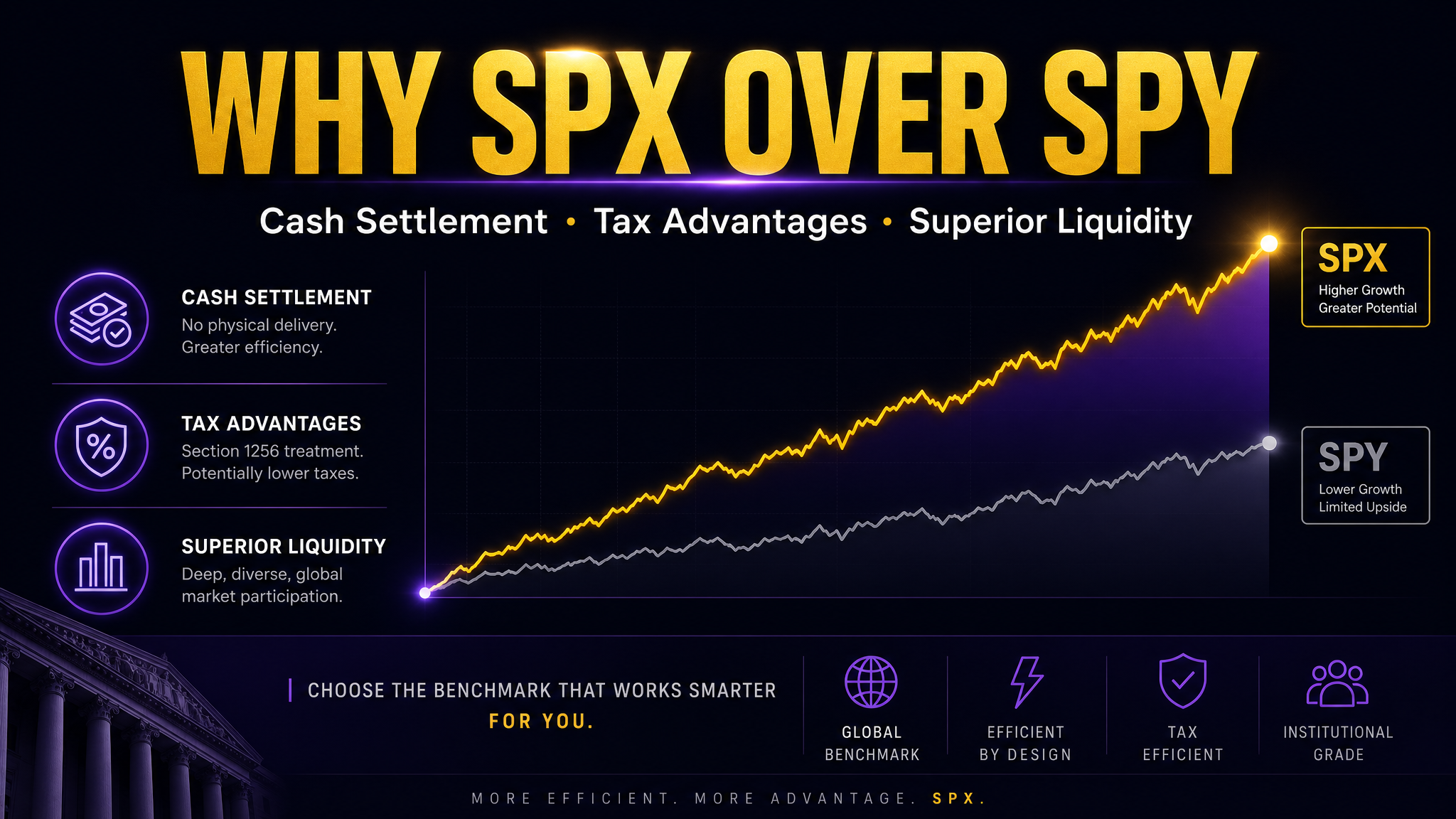
The Core Difference: Index vs. ETF
SPY is an ETF — an exchange-traded fund that tracks the S&P 500 by holding a portfolio of stocks. When you trade SPY options, you're trading options on that ETF.
SPX is the actual S&P 500 index. When you trade SPX options, you're trading options directly on the index itself — not a fund that approximates it.
This distinction matters because SPX options have different settlement mechanics, tax treatment, and exercise rules than SPY options. For day traders — especially 0DTE traders — these differences compound into a significant structural edge.
Cash Settlement Eliminates Assignment Risk
SPY options are physically settled. If you sell a multi-leg structure on SPY and one of your short strikes goes ITM at expiration, you could be assigned shares — and suddenly you're long or short 100 shares of SPY that you never wanted.
SPX options are cash settled. At expiration, the difference between the strike and the settlement value is paid in cash. No shares change hands. No surprise margin calls. No managing an equity position you didn't ask for.
For 0DTE traders running Condors, Butterflies, or Vertical Spreads, cash settlement eliminates the single biggest operational risk: unintended assignment on expiration day.
The 60/40 Tax Advantage (Section 1256)
Under IRS Section 1256, broad-based index options like SPX receive preferential tax treatment. Regardless of how long you hold the position — even if it's minutes — gains are taxed as:
60%
Long-term capital gains rate
40%
Short-term capital gains rate
SPY options don't get this treatment. Every trade under 12 months is taxed at your full short-term rate. For active 0DTE traders, the difference can be thousands of dollars per year in tax savings.
If you make $50K/year trading 0DTE and you're in the 35% tax bracket, the 60/40 rule on SPX could save you roughly $4,000–$5,000 compared to SPY's 100% short-term treatment. That's real money left on the table.
Liquidity: SPX Dominates 0DTE Volume
0DTE options have exploded in popularity. And the vast majority of that volume is in SPX, not SPY.
SPX 0DTE options now represent over 50% of all SPX options volume on a daily basis. The bid-ask spreads are tight, the open interest is massive, and the fills are fast. This kind of liquidity means:
- Lower slippage on entries and exits
- Better fill prices on multi-leg strategies
- Ability to get out fast during volatile moves
- Reliable pricing for real-time decision-making
While SPY has liquidity too, the institutional money in 0DTE is concentrated in SPX. When market makers, hedge funds, and algorithmic traders are all quoting SPX, the result is a deeper, tighter market.
PDT Rule Eliminated — The Game Changed
On June 4, 2026, the SEC officially eliminated the Pattern Day Trading (PDT) rule. For years, the $25,000 minimum equity requirement prevented retail traders from actively day-trading. That barrier is now gone.
This is a massive catalyst for 0DTE SPX trading specifically, because:
- Traders with smaller accounts can now enter and exit 0DTE positions freely
- No more worrying about "day trade" counts — trade as often as your edge allows
- The influx of new participants increases volume and competition, tightening spreads further
The elimination of PDT doesn't just remove a restriction — it opens the door for millions of traders who were previously locked out of active 0DTE strategies. SPX is where the volume is going.
European-Style = No Early Exercise
SPY options are American-style, meaning they can be exercised at any time before expiration. If you're short an SPY option that goes deep ITM, the counterparty can exercise it early — and you're stuck managing an unexpected assignment.
SPX options are European-style. They can only be exercised at expiration. This gives you complete control over the position for the entire life of the trade. No surprises, no early assignment risk.
For 0DTE trades, this is especially relevant because short options can go ITM and come back out of the money within the same session. With SPX, you ride it out. With SPY, you might get exercised before price reverts.
Putting It Together: SPX for 0DTE
The case for SPX over SPY isn't about one single advantage — it's the compounding effect of all six:
Cash settled: No assignment, no shares, no operational risk
60/40 tax: Lower effective tax rate on every trade
Deep liquidity: Tighter spreads, better fills, faster exits
No PDT: Trade freely with any account size
European-style: No early exercise, full position control
Volume growth: 0DTE SPX is the fastest-growing segment in options
If you're trading 0DTE options, you owe it to yourself to trade the instrument that gives you the most structural advantage. That instrument is SPX.