
01Why I Stopped Trading Signals
For years I traded the signal. A candle pattern, an indicator cross, a level that “should” hold. Sometimes it worked. When it didn’t, I couldn’t tell you why, and that was the real problem. A trade you can’t explain is a trade you can’t repeat.
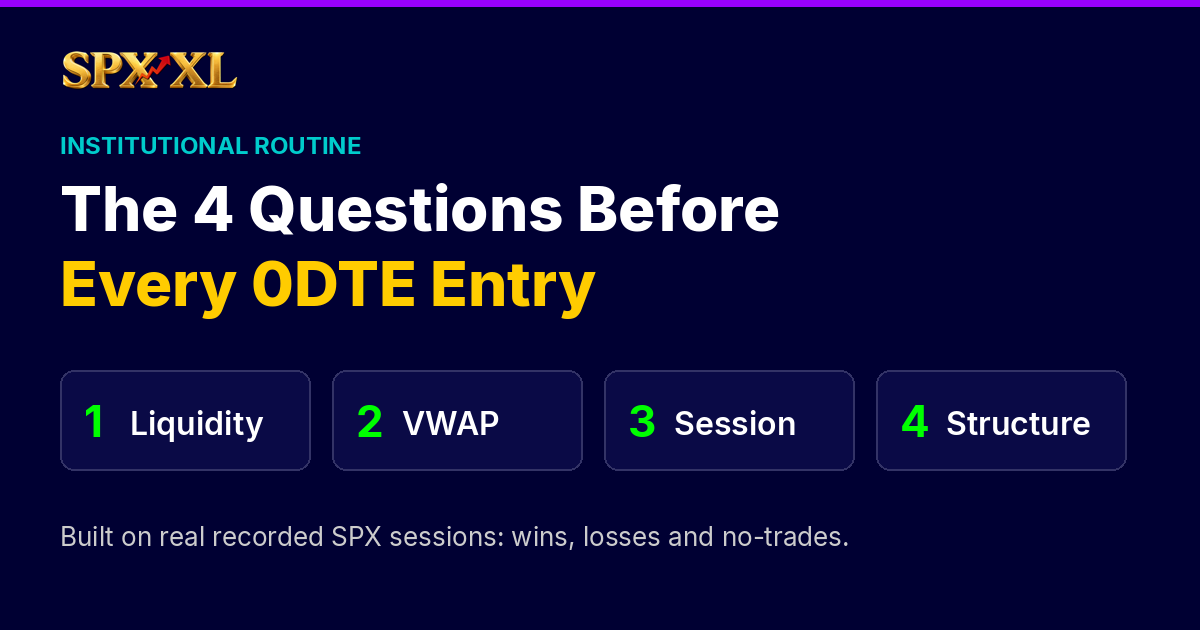
The desks that move SPX don’t trade signals. They trade location. Before anything else, they ask where the stops are resting, where fair value sits, what time of day it is, and whether price has actually proven its intent. That’s four questions. I answer the same four before every 0DTE entry, and if any answer is no, I wait.
This article walks through each question, then shows it on two real sessions from the SPXXL record — one where the rules kept me out of a whole losing morning, and one where I followed every rule and still took the stop. Both matter.
02Question 1: Where Is the Liquidity?
Liquidity is where stop orders cluster. On SPX that means the obvious levels everyone can see: the Previous Day High and Low, the Overnight High and Low, the session extremes, and Equal Highs and Lows that look like a double top or bottom. The more obvious the level, the more stops sit behind it. That’s a Liquidity Pool.
When price reaches a pool, one of two things happens, and telling them apart is the whole game:
Liquidity Sweep
Price wicks through the level and closes back inside. The stops got taken and the market rejected the new price. This is the setup a reversal can come from.
Acceptance
Two closes beyond the level. Price broke it and held. The break is real, and fading it is the most common losing trade in day trading.
So question one isn’t “is price at a level?” It’s “did price sweep the level, or was it accepted?” A sweep that fails to reclaim is a Sweep-and-Fail, and that one tells you to stand aside too.
03Question 2: Which Side of VWAP?
VWAP is the session’s volume-weighted fair value. It’s the price the big desks benchmark their fills against, so it acts like a magnet and a dividing line at the same time.
After a sweep, I want price back on the right side of VWAP for the direction I’m taking. A long needs price reclaiming VWAP from below — a VWAP Reclaim. A short needs price losing it from above. Two more checks live here. If VWAP is flat, there’s no trend to join and the day is a range. If price is already two standard deviations away, it’s a VWAP Stretch and I’m late.
04Question 3: What Session Is It?
The same setup behaves differently at 9:35 AM and at 12:30 PM. So the clock is a rule, not a suggestion. All times are Eastern:
Opening Grab · 9:30–9:45
The first fifteen minutes hunt stops in both directions. I watch. I don't enter.
Open Drive · 9:45–10:30
The cleanest window of the day. Full size is allowed when the other three questions agree.
Midday Lull · 11:30–1:30
Volume dries up and sweeps fake out more often. The checklist automatically reads Wait.
The Opening Drive and the Midday Lull each have their own glossary entry if you want the full reasoning.
05Question 4: Did Structure Confirm?
A sweep is an opportunity. It isn’t proof. Proof is structure. After the sweep, price has to break the opposing swing point — the last swing high for a long, the last swing low for a short.
When that break comes within a couple of hours of the sweep, it’s a Structure Shift: the sweep trapped one side, and the break shows the other side took control. A break without a recent sweep is a plain Break of Structure. Either one answers question four. No break, no entry.
When all four answers are yes, the Institutional Checklist on the SPXXL chart turns Go and the Playbook arms a plan: the entry, a stop beyond the sweep, and the nearest untouched Liquidity Pool as the target.
06A Real Session: August 27, 2026
Here’s the routine on a recorded session. SPXXL classified 2026-08-27 as a Liquidity Sweep day at 38% confidence. SPX opened at 7710.34, traded between 7689.89 and 7741.27, and closed at 7730.11. Every level and time below comes from the recorded 5-minute bars.
- 9:35SPX closes above the Previous Day High (7690.73) and holds. That is Acceptance, not a sweep.
- 9:40–10:10Checklist: No-Go. Liquidity failed. I do not fade a Break-and-Hold.
- 10:25A short reversal starts building. Structure has not confirmed, so the Playbook reads Building, not Armed.
- 10:35–10:50The Initial Balance High (7716.89) is swept, then accepted at 10:50. The short idea is Invalidated. Price pushes 12.09 points higher in the next 30 minutes.
- 14:55Equal Lows at 7711.38 get swept and price closes back inside. A Liquidity Sweep, finally.
- 15:05Go long. Sweep, VWAP, Session, Structure all line up. Armed: entry at VWAP 7718.61, stop 7710.17, target the Session High 7741.27.
- 15:10Filled. The target is never reached. SPX closes at 7730.11 — 11.50 points in favor, still open at the bell.
Look at the morning first. Anyone fading the break of yesterday’s high at 9:40 was selling into Acceptance. Question one said no, so there was no trade. The first short idea at 10:25 never got structure confirmation, and when the Initial Balance High was accepted at 10:50 the idea was dead. Price went 12.09 points the other way in the next half hour. Waiting cost nothing.
The afternoon is the setup the routine is built for. The Equal Lows at 7711.38 were swept at 14:55 and price closed back inside. At 15:05 price was back above VWAP, the session allowed entries, and structure broke up. All four questions said yes.
The plan mapped to a 7720/7725 Call Debit Spread. The target at the Session High was never reached, so the trade didn’t “win” the way the plan drew it. SPX closed at 7730.11, above both strikes, so the spread finished at its full 5.00 — $500 per contract at expiration. The debit wasn’t recorded, so I won’t claim a profit number. What I can say is that the rules kept me out of the morning and put me in the afternoon.
07A Real Loss: August 24, 2026
If I only showed you 08-27 I’d be selling you something. Three sessions earlier, on another Liquidity Sweep day (42% confidence), the same four questions lined up short at 13:30. The plan: entry 7654.43, stop 7663.81, target the Equal Lows at 7642.18, mapped to a 7655/7650 Put Debit Spread.
It filled at 14:00. It hit the stop at 14:20. SPX closed the day at 7652.82.
That’s a Valid Loss. Every rule was followed, the stop sat where the idea was proven wrong, and the risk was defined before entry. A Valid Loss isn’t a mistake. Breaking a rule is the mistake, even when it happens to make money.
08The Honest Numbers
I ran the checklist and Playbook bar by bar across every session in the SPXXL record, from 2026-05-28 to 2026-09-25. Here’s what came out, without the flattering parts cut:
19
Reversal Models armed
12
Never filled
4
Filled, hit the stop
3
Open in favor at the close
Zero of the 7 filled trades reached their target. The target is the nearest untouched pool, and on these sessions price rarely traveled that far after the entry. That’s the kind of thing you only learn by testing the rules on real bars instead of cherry-picked charts.
Sweeps themselves are rarer than most courses admit. Mark the Previous Day High and Low, the Session High and Low, and VWAP at 10:30 AM on 78 recorded sessions and you get 390 lines. Only 30 were swept after the mark. 169 were accepted. 191 were never touched. Most of the time the right answer to question one is “not yet.”
That’s why I built the 5-Line Challenge. You get a real recorded session frozen at 10:30, call each line Swept, Accepted or Untouched, then watch the rest of the day replay. It’s FREE, and it trains question one faster than anything I know.
09Layer 2: Reading Order Flow
The four questions are Layer 1: location. Once they’re second nature, Layer 2 is reading who is actually trading at those levels. These are the deeper reads I’d go to next:
See the Checklist live
The Institutional Checklist and Playbook sit on the SPXXL chart and update every bar.
Open the chartTrain question one
Call five lines on a real recorded session, then watch what happened.
Play the 5-Line ChallengeRun the four questions on a live session.
Five full trading days of Elite access. No cost. Nothing to cancel.
The market opens again tomorrow and a new session gets classified.
This article is educational and uses recorded SPX sessions for illustration. It is not financial advice, past sessions do not predict future ones, and no outcome is guaranteed.