
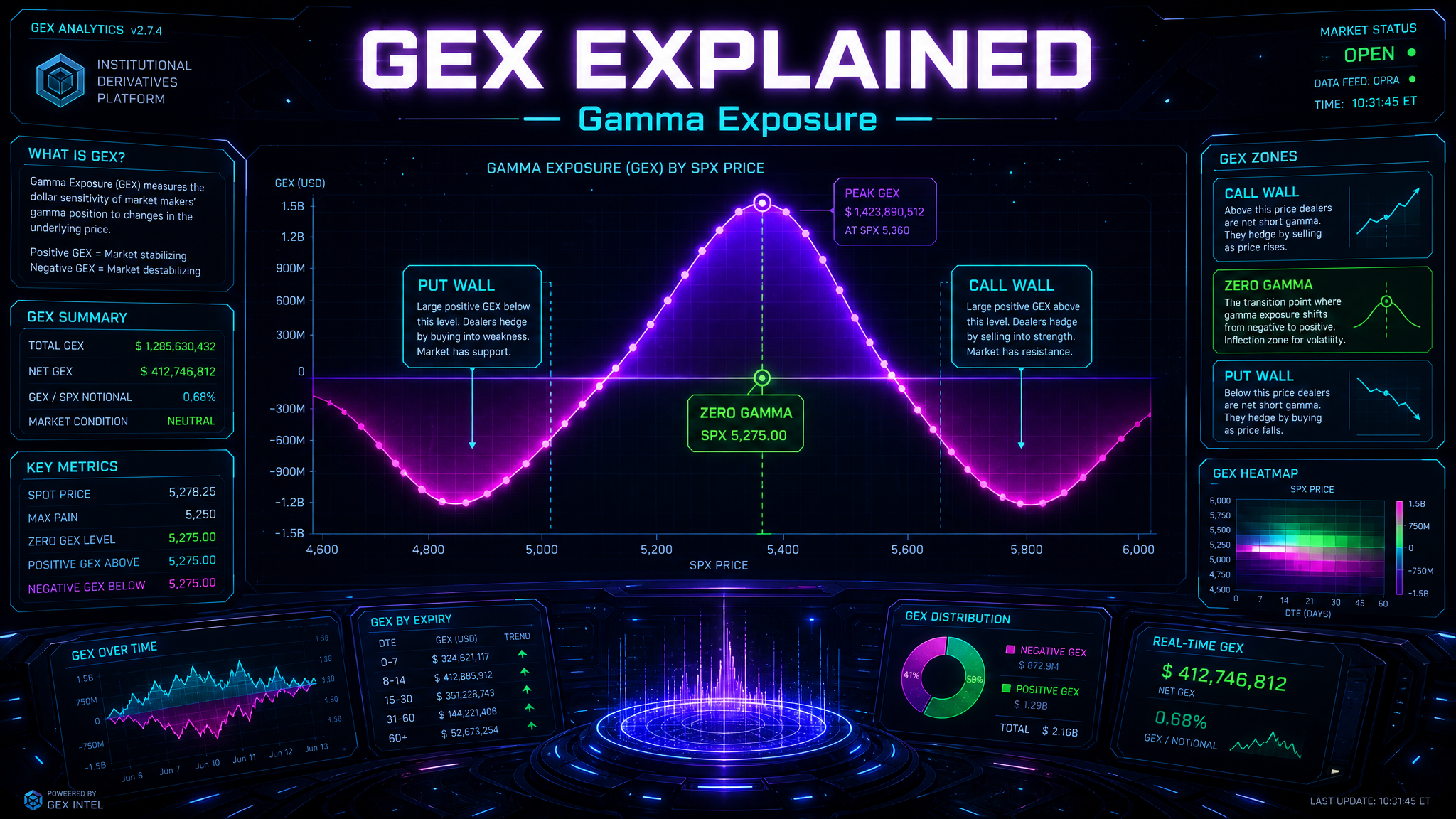
What Is Gamma Exposure (GEX)? The 60-Second Version
Imagine the SPX options market as an ocean. Price is the surface. But beneath the surface, there are invisible currents created by millions of open options positions. These currents push price toward certain levels and away from others. Gamma Exposure (GEX) measures the strength and direction of these currents.
GEX in One Sentence
GEX = how much SPX do market makers need to buy or sell to stay hedged as price moves $1?
When GEX is positive, market makers are fighting the price move (they sell when price goes up, buy when it goes down). This suppresses volatility and creates range-bound markets.
When GEX is negative, market makers are feeding the price move (they buy when price goes up, sell when it goes down). This amplifies volatility and creates Trending markets.
Why Market Makers Are the Invisible Hand
To understand GEX, you need to understand who market makers are and what they do:
- Market makers provide liquidity. When you buy a 0DTE SPX Call, a market maker is usually the one selling it to you. They don't take directional bets — they earn the bid-ask spread.
- They must stay delta-neutral. After selling you that Call, the market maker has negative delta exposure. To hedge, they buy SPX futures or shares. As price moves, they must continuously adjust these hedges.
- Gamma determines how much they hedge. Gamma is the rate of change of delta. High gamma means small price moves require large hedge adjustments. This hedging activity moves the underlying market.
Here's the key: market makers don't choose to move the market. They are mechanically forced to. Their hedging algorithms execute automatically based on their gamma exposure. This means GEX creates predictable price behavior patterns — not in terms of direction, but in terms of how the market will move.
Positive GEX: The Volatility Suppressor
When total GEX across all strikes is positive, market makers are net long gamma. This happens when there's heavy open interest in Call options that dealers have sold. Their hedging behavior creates a volatility-suppressing feedback loop:
Positive GEX → Stabilizing Feedback Loop
What this looks like on a chart: Price bounces between narrow levels. Rallies get sold. Dips get bought. The intraday range is tight relative to the Average Daily Range (ADR). The market feels "sticky" and difficult to break out of. Sound familiar? This is a Balanced Day.
Negative GEX: The Volatility Amplifier
When total GEX is negative, market makers are net short gamma. This happens when there's heavy Put buying (hedging demand, fear). Their hedging behavior creates a volatility-amplifying feedback loop:
Negative GEX → Amplifying Feedback Loop
What this looks like on a chart: Price moves persistently in one direction with minimal pullbacks. The intraday range expands well beyond ADR. Moves accelerate into the close. Breakouts follow through instead of fading. This is a Trend Day or Expansion Day.
The Structural Levels: Call Wall, Put Wall, Zero Gamma
GEX doesn't just create general behavior — it creates specific price levels where dealer hedging activity concentrates. These levels act as magnets, barriers, and inflection points:
Call Wall
The strike with the highest positive Call gamma. As price approaches from below, increasing dealer selling creates resistance. Think of it as a ceiling that gets harder to break through. Price often stalls or reverses here.
Put Wall
The strike with the highest positive Put gamma. As price drops toward it, increasing dealer buying creates support. Think of it as a floor. Sharp bounces often originate from the Put Wall level.
Zero Gamma Level
The price where aggregate GEX flips from positive to negative. Above Zero Gamma = stabilizing regime. Below = amplifying regime. This is the most important structural level in the entire options market.
High Volatility Level (HVL)
The threshold beyond which dealer hedging is projected to significantly accelerate. Breaching HVL often confirms breakout setups and indicates the market has entered a Trending regime.
GEX + Session Types: The Connection That Changes Everything
Here's where GEX stops being academic and becomes actionable. GEX regimes map directly to SPXXL's session types:
GEX Regime → Session Type Mapping
This mapping is not a coincidence — it's causal. Positive GEX creates the mean-reverting behavior that defines Balanced Days. Negative GEX creates the Trending behavior that defines Trend Days and Expansion Days. The session type is the market's GEX regime expressed as price behavior.
How to Read GEX as a 0DTE Trader
You don't need a PhD in financial engineering to use GEX. Here's the practical framework for 0DTE traders:
Pre-Market (8:00-9:30 AM ET)
Check overnight GEX levels. Identify Zero Gamma, Call Wall, Put Wall. Determine if the market opens in positive or negative territory.
IB Formation (9:30-10:30 AM ET)
Watch how price interacts with GEX levels during the Initial Balance. Does price respect the Call/Put Walls? Does it break through Zero Gamma?
Core Session (10:30 AM - 2:30 PM ET)
Monitor the regime. If price stays above Zero Gamma, Balanced Day structures are working. If it breaks below, prepare for Trending behavior.
Power Hour (3:00-4:00 PM ET)
GEX effects intensify as 0DTE gamma peaks. Avoid new positions. Let theta work on existing positions.
The golden rule of GEX: Don't use GEX to predict direction. Use it to predict behavior. Positive GEX = stable, range-bound. Negative GEX = volatile, Trending. Then choose your structure accordingly.
The SPXXL GEX Integration
SPXXL integrates GEX into its intelligence framework through the Options Analytics layer — one of the seven dimensions in the scoring engine. Here's what this means for you:
GEX Regime Detection
The Options Analytics layer identifies whether the market is in positive or negative GEX territory and factors this into session classification.
Structural Level Awareness
Call Wall, Put Wall, and Zero Gamma levels are incorporated into the confidence scoring, increasing confidence when price respects these levels.
Session Type Validation
GEX regime serves as a validation layer. A Balanced Day classification with confirmed positive GEX has higher confidence than one without.
Regime Transition Alerts
When GEX flips from positive to negative (or vice versa), the engine detects the regime change and can reclassify the session in real-time.
The power of SPXXL isn't that it gives you raw GEX numbers — it's that it translates GEX into actionable session types. You don't need to calculate gamma across every strike. You just need to know: is today a Balanced Day or a Trend Day? The GEX analysis is already baked into the answer.
The invisible hand moves the market.
SPXXL makes it visible.
Start with a 5-Day Trial. 5 live sessions with full GEX-aware session classification, confidence scores, and structure recommendations. See the regime before you trade.
Disclaimer: Options trading involves substantial risk of loss and is not suitable for all investors. Gamma Exposure (GEX) analysis is one of many factors in market analysis and does not guarantee trading success. GEX levels are dynamic and can change throughout the session. SPXXL provides analytical tools and session classification — it does not provide financial advice or guaranteed outcomes. Always trade with capital you can afford to lose and consider consulting a licensed financial advisor.