
What the PDT Rule Was (And Who It Really Protected)
The Pattern Day Trader rule — FINRA Rule 4210 — was introduced in 2001, in the wake of the dot-com crash. The stated purpose was to "protect retail investors from themselves." The real effect? It created a two-tier market: those with $25,000 could trade freely, and those without were locked out.
If your margin account dipped below $25,000 and you executed four or more day trades in five business days, your account was frozen for 90 days. Not warned. Frozen. You could watch the market. You just couldn't participate in it.
For 25 years, the PDT rule told aspiring traders the same story: you don't belong here unless you have enough money. It was a wealth gate dressed up as consumer protection. Meanwhile, institutional traders — the ones actually creating the volatility that retail traders were being "protected" from — faced no such restriction.
The psychological damage was worse than the financial restriction. The PDT rule created a scarcity mindset — a belief that the market was inherently exclusionary. That day trading was "too dangerous" for regular people. That you needed to ask permission to participate in the public markets.
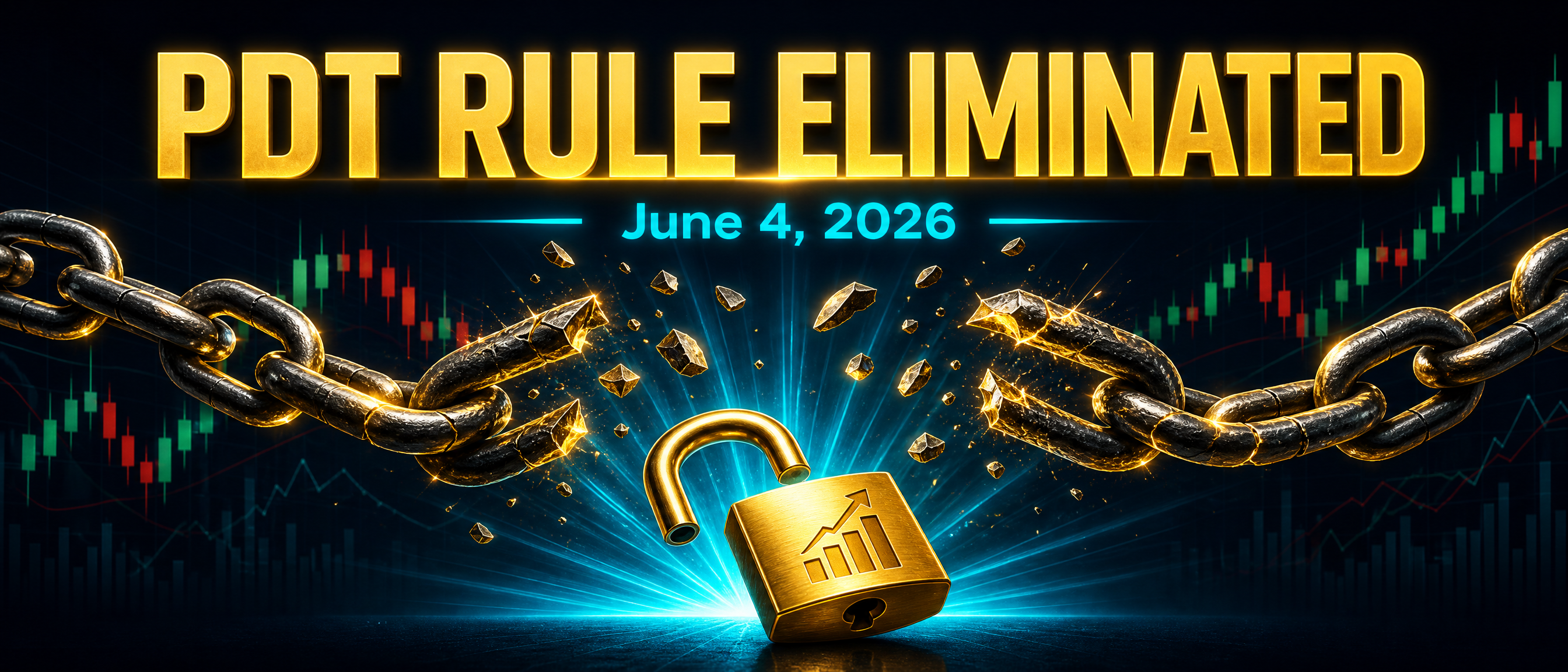
June 4, 2026: The Day the Chains Broke
Today, the SEC officially approved FINRA's proposal to eliminate the Pattern Day Trader rule. Effective immediately. No phase-in period. No asterisks.
Before June 4
$25,000 minimum to day trade
90-day freeze if violated
4 trade limit per 5 days
After June 4
No minimum for day trading
No freeze risk
Unlimited trades
This isn't a rule change. This is a paradigm shift. The financial industry just told every retail trader in America: the velvet rope is gone. You can sit at the table now.
And the timing is not coincidental. 0DTE options now account for over 40% of total SPX volume. Retail participation in options markets has surged. The infrastructure — instant execution, $0 commissions, sophisticated analysis tools — has caught up to the opportunity. The PDT rule was a relic from an era when a trade took a phone call and a $49.95 commission. That era is dead.
Why 0DTE Options Are the Biggest Beneficiary
Of all trading strategies, 0DTE (zero days to expiration) options benefit the most from the PDT rule's elimination. Here's why:
- 0DTE is inherently intraday. These options expire at market close. You must manage them within the session. Under the PDT rule, small account traders were penalized for doing the right thing — closing positions before expiration instead of holding them to zero.
- Defined-risk strategies need active management. Debit Spreads, Debit Condors, and Debit Butterflies all benefit from intraday adjustments. The PDT rule forced traders to "set and forget" strategies that are designed to be actively managed.
- Gamma risk accelerates on 0DTE. A position that's safe at 10 AM can be underwater by 2 PM. Not being able to close it because you'd trigger a PDT flag was like telling a firefighter they can only use the hose twice this week.
- Small accounts can now trade the right size. A $5,000 account can now freely enter and exit a $500 SPX Debit Spread multiple times per day, scaling position size appropriately to their capital — exactly how professionals manage risk.
The Psychology of Artificial Scarcity
The PDT rule created something more powerful than a financial barrier — it created a psychological one. Behavioral economics calls this the scarcity heuristic: when something is restricted, people perceive it as more valuable, and perceive themselves as less capable of accessing it.
For a generation of aspiring traders, the internal narrative was: "I can't day trade because I don't have $25K. I'm not at that level yet." This wasn't about money — it was about identity. The PDT rule made people believe they weren't ready, when the real barrier was an arbitrary regulatory threshold.
Psychologist Daniel Kahneman demonstrated that loss aversion — the pain of losing something is roughly twice as powerful as the pleasure of gaining it — drives most financial decisions. The PDT rule weaponized this: the fear of losing the ability to trade (a 90-day freeze) was more paralyzing than any actual trading loss.
Today, that fear is gone. And with it, the artificial ceiling on who gets to participate.
But here's the critical insight: removing the barrier doesn't automatically create the edge. The millions of traders who are entering the market today need more than access — they need a framework for making decisions. Which brings me to the part that matters most.
What Changes for Small Account Traders
If you have a trading account under $25,000, today is the first day you can trade the way professionals have always traded. Here's what's now possible:
Scale In & Out Freely
Enter a half-size position, add if the trade works, trim if it doesn't — without counting trades.
Cut Losers Instantly
No more holding a losing Debit Spread overnight because closing it would trigger your 4th day trade.
Trade Multiple Sessions
Take a morning trade, close it, re-enter in the afternoon session with a fresh read. Every day.
Proper Position Sizing
Risk 1-2% per trade, take 3-5 setups per week, and compound — the math now works at every account size.
The common denominator in all of these? They require knowing what kind of day you're in. You can now freely enter and exit trades — but entering the right trade for the current session type is what separates profitable traders from active traders who lose money faster.
The 5 Strategies Now Unlocked for Everyone
These strategies were always available to traders with $25K+. As of today, they're available to everyone:
Intraday Debit Spreads
Buy a directional Debit Spread in the morning, sell it for a profit as price moves in your favor. The classic 0DTE play — now without the fear of triggering PDT on the closing trade.
Best on Trend Day sessions with clear directional bias
Momentum Scalps
Buy directional 0DTE options on high-conviction Trend Day or Expansion Day sessions. Enter fast, exit faster. Previously impossible for sub-$25K accounts without burning all 4 trades.
Best on Trend Day & Expansion Day sessions
Debit Condor Day Trades
Buy both a Bull Call and Bear Put Debit Spread simultaneously, profiting from a range-bound session. Manage each side intraday — something the PDT rule made impossible.
Best on Balanced Day & Volatility Compression sessions
IB Break Continuation Plays
When price breaks the Initial Balance range, the session often runs. Enter on the break, trail to the ADR target. Requires intraday exits that PDT penalized.
Best on Expansion Day & Trend Day sessions
Sweep Fade Reversals
Liquidity sweeps create the best short-term reversals in SPX. Fade the sweep, take profit at VWAP. A 15-minute hold that counted as a "day trade" under the old regime.
Best on Liquidity Sweep sessions
Notice the pattern? Every strategy requires knowing the session type. Range structures on a Trend Day bleed money. Directional plays on a Balanced Day session get chopped. The PDT rule didn't just limit how many trades you could make — it made it impossible to match your strategy to the market regime.
That's the problem SPXXL solves. And today, for the first time, everyone can actually use it the way it was designed to be used.
Your 5-Day Trial: Timing Is Everything
I built SPXXL to classify SPX sessions in real time — to tell you whether it's a Balanced Day, Trend Day, Expansion Day, Volatility Compression, Liquidity Sweep, or Short Covering Rally before you place a trade. It scores the session across 7 dimensions and recommends which options structure fits.
And I believe so strongly that one session isn't enough to understand what this tool does for your trading that I give every new user a full trading week — 5 live market sessions — of complete Elite access.
Your 5-Day Trial Includes:
- 5 live market sessions of full Elite access
- Real-time session classification & 7-dimension scoring
- Complete dual-panel chart engine with all overlays
- IB / ADR / VWAP levels, MFE/MAE targets, sweep arrows
- Strategy recommendations matched to the current session type
- No cost — zero commitment
The timing is deliberate. The PDT rule just died. Millions of traders are entering the 0DTE market today for the first time. Most will trade blind — picking structures based on gut feeling, YouTube tips, or whatever their Discord channel is hyping.
The ones who start with a framework for classifying the session will have an edge that compounds every single trading day. After 5 sessions, you'll know whether SPXXL is that framework for you. I think the answer will be obvious.
What Happens Next
The PDT rule's elimination will trigger a wave of new retail participation in 0DTE options. Here's what I expect:
- →Volume will surge. More participants means more liquidity, tighter spreads, and better fills for everyone. The SPX 0DTE ecosystem becomes more efficient, not less.
- →Many will lose money. Access without edge is expensive. The traders who enter the market without understanding session types, gamma risk, or theta decay will fund the traders who do.
- →The edge goes to preparation. In a market where everyone can now trade freely, the differentiator is no longer capital — it's information. Knowing whether today is a Balanced Day or a Trend Day before you enter a position is the single highest-leverage decision in 0DTE trading.
- →The tools matter more than ever. With unlimited trades available, the risk of overtrading is real. Session classification acts as a filter — it doesn't just tell you what to trade, it tells you when not to trade.
The PDT rule kept millions of traders out of the market. Its removal brings them in. But the market doesn't care about participation — it rewards preparation.
The barrier is gone.
The question is whether you'll trade with an edge or without one.
Your first full trading week is on me. 5 live market sessions. Full Elite access. No cost. See the session type before you trade — then decide.
Disclaimer: Options trading involves substantial risk of loss and is not suitable for all investors. Past performance does not guarantee future results. SPXXL provides analytical tools and session classification — it does not provide financial advice, specific trade recommendations, or guaranteed outcomes. The elimination of the PDT rule does not reduce the inherent risks of options trading. Always trade with capital you can afford to lose and consider consulting a licensed financial advisor.