The One-Sentence Definition of an Option
Let's take it all the way back to the beginning. When people talk about “the market,” they often mean the S&P 500 — the 500 largest U.S. companies bundled into a single number. That number is the SPX index. When SPX is at 6000, that is simply the current level of the market.
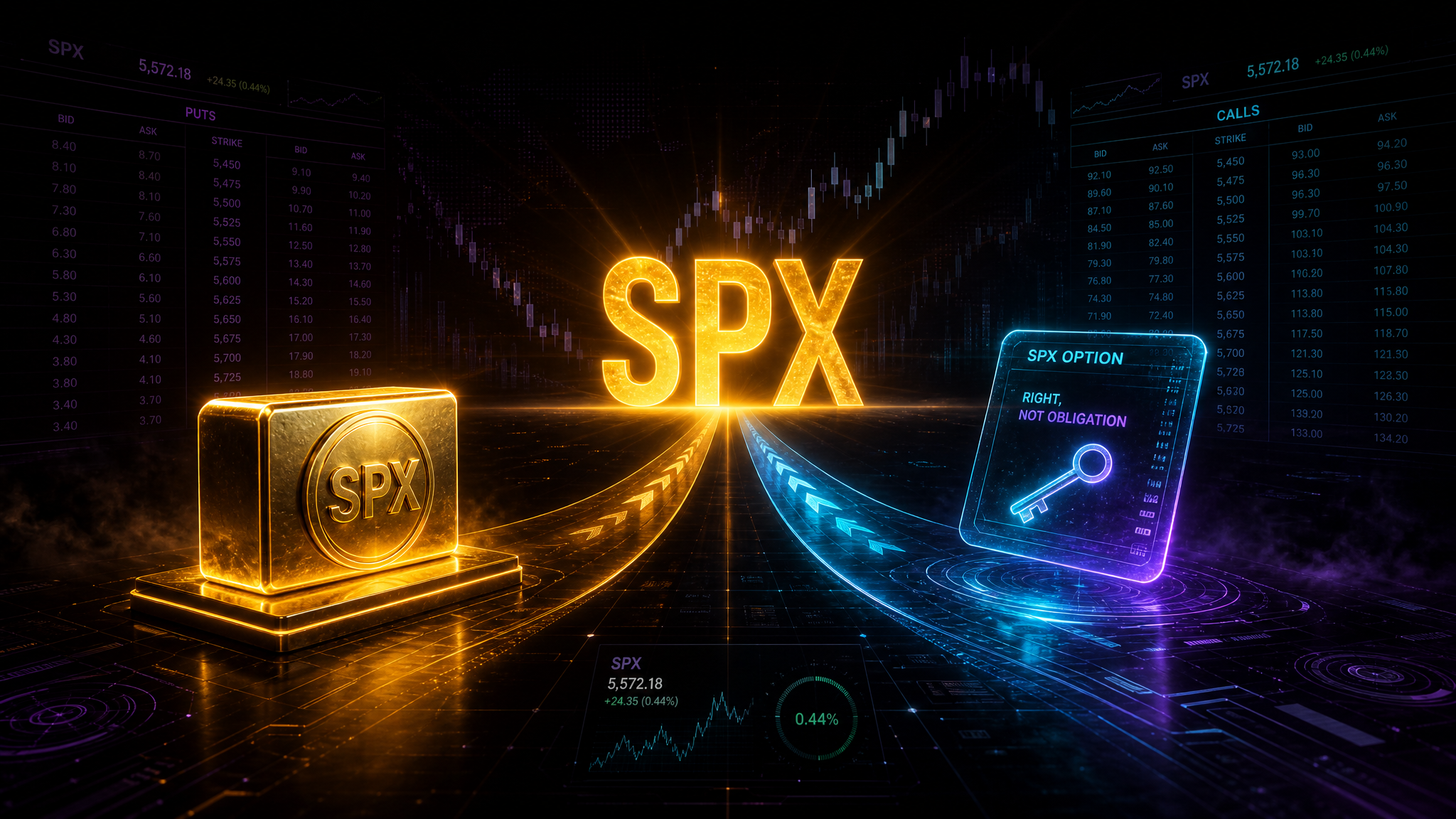
An option is not the market. An option is a contract that gives you the right — but never the obligation — to buy or sell something at a set price, before a set date.
An Option in One Sentence
An option is a contract that lets you make a bet on where SPX is heading — for a small, fixed cost — without ever having to own SPX itself.
Read that again, because it is the whole game. You are not buying the market. You are buying a choice about the market. That single distinction is what separates option trading from every other kind of investing — and it is exactly where most beginners get confused.
A Real-Life Analogy: The Reservation
Imagine you find a house listed at $500,000. You think its value is about to jump, but you are not ready to buy the whole house today. So you pay the seller $5,000 for a signed agreement: for the next 30 days, you have the right to buy that house for $500,000 — no matter what happens to the price.
- If the house jumps to $560,000, you use your agreement, buy at $500,000, and you are instantly ahead. Your $5,000 controlled a $500,000 asset.
- If the house drops to $450,000, you simply walk away. You are not forced to buy. You only lose the $5,000 you paid for the agreement.
That signed agreement is an option. The $5,000 is the premium. The $500,000 is the strike price. The 30-day window is the expiration. Now just swap the house for SPX — and you understand exactly what an SPX option is.
The Big One: Buying SPX vs. Buying an SPX Option
This is the section your whole journey hinges on. There are two completely different ways to “bet on SPX,” and beginners constantly mix them up. Let's make them crystal clear.
First, an honest note: you cannot literally buy the SPX index like a share of stock — SPX is just a number that measures the market. Traders get direct exposure to it in index-like ways (for example, through an S&P 500 fund or futures) where your money moves dollar-for-dollar with the index. For learning, think of “buying SPX” as owning the market directly.
Owning SPX Directly
- • You own the market exposure — you rise and fall with SPX.
- • Moves are one-to-one: if SPX rises 1%, your position rises about 1%.
- • It takes a large amount of capital to hold meaningful size.
- • There is no expiration — you can hold for years.
- • Risk is large and open-ended: a 10% drop is a 10% loss on your full position.
Buying an SPX Option
- • You own a contract, not the market — a right, not ownership.
- • Moves are leveraged: a small SPX move can be a big percentage move on your premium.
- • It costs a small premium — often a fraction of owning the market.
- • It has an expiration date — and loses value as time passes.
- • As a buyer, your risk is capped at the premium you paid.
| Question | Owning SPX Directly | Buying an SPX Option |
|---|---|---|
| What do you own? | The market exposure itself | A contract (a right) |
| Upfront cost | Large (full exposure) | Small (the premium) |
| Most you can lose | Your whole position value | Only the premium paid |
| Does time hurt you? | No expiration | Yes — value decays to expiration |
| Leverage | One-to-one with SPX | Amplified — a little goes far |
Calls and Puts, Explained in Plain English
Every option is one of two types. That's it — just two. Let's use SPX sitting at 6000 for both.
A Call Option = Betting Up
A call gives you the right to buy at a set price. You buy a Call when you think SPX will rise. If you buy a 6010 call and SPX climbs to 6080, your right to “buy at 6010” becomes valuable. The higher SPX goes, the more your Call is worth.
A Put Option = Betting Down
A put gives you the right to sell at a set price. You buy a Put when you think SPX will fall. If you buy a 5990 put and SPX drops to 5920, your right to “sell at 5990” becomes valuable. The lower SPX goes, the more your Put is worth.
The Three Numbers Every Option Has
Every option — no matter how complex it looks on a screen — is defined by just three numbers. Learn these three and you can read any option quote.
When you hear traders say “0DTE” (zero days to expiration), they simply mean an option that expires today. It is the purest, fastest version of the time-and-distance game — and it is exactly what SPXXL is built to help you read.
Why Beginners Actually Use Options
If options add distance and time to worry about, why bother? Because they give beginners two powerful advantages that owning SPX directly cannot.
- Defined, known risk. When you buy an option, you decide your maximum loss the moment you pay the premium. If you spend $300 on an SPX Call, the worst case is losing that $300 — even if the market crashes. You always know your downside before you enter.
- Leverage from a small account. Owning meaningful SPX exposure directly takes a lot of capital. A single option lets a small account participate in the same SPX move for a fraction of the cost.
Reading a Real SPX Option, Start to Finish
Let's put every piece together with one clean SPX example. Say SPX is trading at 6000 and you believe it will rise today. You buy:
One SPX 6010 Call, expiring today, premium $5.00
Your breakeven is simple: strike plus premium = 6010 + 5 = 6015. Here is how the day can end:
- SPX closes at 6040: your Call is deep in profit — it sits 30 points above your strike, and at $100 per point that is $3,000 of intrinsic value, far more than the $500 you paid.
- SPX closes at 6015: you break even — the move covered your premium exactly.
- SPX closes at 5990: you simply let it expire. You lose only your $500 premium — nothing more, no matter how far SPX fell.
Notice the beauty of it: your downside was fixed and known the whole time, but your upside grew with every point SPX climbed. That asymmetry is the entire reason options exist.
How SPXXL Helps You Start
Now you know what an option is, how it differs from owning SPX, and the three numbers that define it. The next question every beginner asks is the hard one: “but how do I know when to buy a Call versus a Put — and when to just stay out?”
That is exactly what SPXXL was built for. Instead of guessing, SPXXL reads the SPX session in real time and tells you what kind of day it is — whether the market is likely to trend, chop sideways, or expand violently. For an option buyer worried about distance and time, that read is everything. It helps you choose the right side, the right strike distance, and — just as often — when the smart move is no trade at all.
- Plain-English session classification, so beginners never trade blind.
- SPX-first tools — every level, zone, and signal is built around the index you just learned about.
- A structured path from “what is an option” to placing your first confident SPX trade.
Keep learning: read Why SPX?, then 0DTE for Beginners, and when you're ready, First Trade Setup.
Ready to Read the Market Like an Options Trader?
You understand what an option is. Now let SPXXL show you what kind of SPX day you're trading — before you ever risk a premium.
Disclaimer: Options trading involves substantial risk of loss and is not suitable for all investors. This article is educational and uses SPX for illustration only — it is not financial advice or a recommendation to buy or sell any security. Examples are simplified for learning and do not account for commissions, fees, bid-ask spreads, or real-world execution. SPXXL provides analytical tools and session classification, not guaranteed outcomes. Always trade with capital you can afford to lose and consider consulting a licensed financial advisor.