
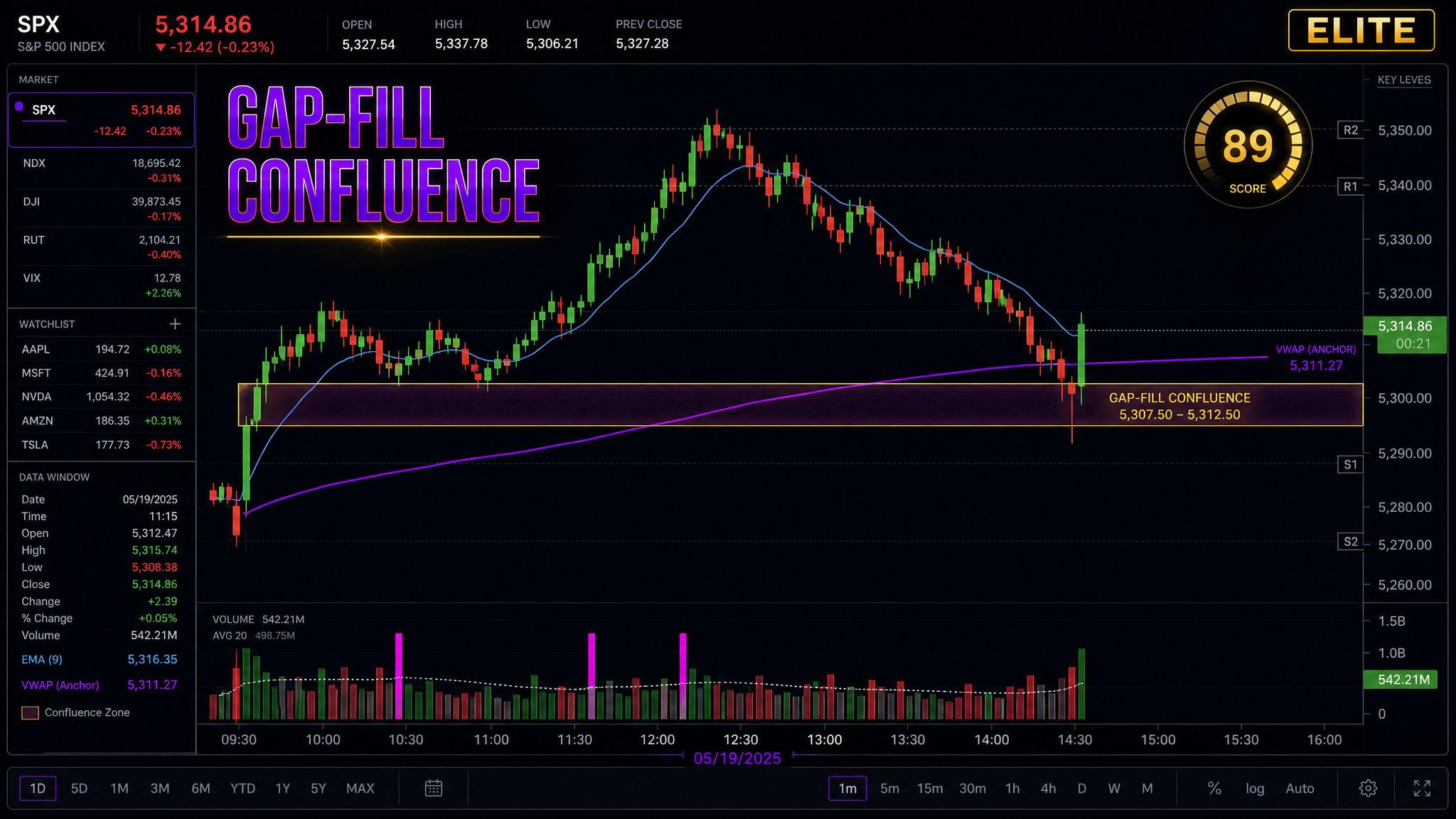
The Gap-Fill Trade Everyone Botches
The gap-fill is one of the oldest patterns in intraday trading: price opens away from the prior close, then “fills the gap” by trading back toward it. It works often enough to be seductive and fails often enough to be dangerous. The problem was never the idea — it was the execution.
Most traders make one of three mistakes:
- They fade the gap immediately at the open, with no level and no confirmation — catching a falling knife.
- They wait for the “full fill” and enter as price closes the gap, precisely where momentum reverses on them.
- They ignore the regime entirely, fading a gap on a Trend Day that has no intention of coming back.
Gap-Fill Confluence exists to solve the timing and location problem. It does not ask “will the gap fill?” It asks a far more precise question: “Is the retrace into the gap stalling at a stack of meaningful levels, and is price rejecting it right now?”
What a Gap Actually Signals
A gap is an overnight repricing. Between yesterday's close and today's open, futures moved on news, flows, or global sessions — and the cash index opens somewhere new. The engine measures that gap in two dimensions the moment the session begins:
- Direction — gap-up (open above prior close) or gap-down (open below).
- Size relative to ADR — the gap as a fraction of the average daily range, not just raw points. A 10-point gap means something very different on a 30-point day than on an 80-point day.
The engine only arms itself when the gap is meaningful — at least 10% of ADR. Below that, there is no gap-fill edge worth trading, and Gap-Fill Confluence stays in its resting no-gap state.
Gap-Up → LONG bias
Fade the retrace DOWN into the pocket, then rejoin the original up-move.
Gap-Down → SHORT bias
Fade the retrace UP into the pocket, then rejoin the original down-move.
Note the direction carefully: the bias is with the gap, not against it. The retrace is the pullback you wait for; the trade is the resumption after price rejects the confluence pocket.
The Five-Stage State Machine
Gap-Fill Confluence is not a static indicator. It is a state machine that walks the session through five defined stages, and it will not hand you an actionable read until the sequence completes in order. This is what keeps it from firing prematurely.
Gap: A meaningful gap (≥10% ADR) is detected and the directional bias is set.
Retrace: Price begins filling the gap, moving back toward the prior close. The engine tracks retrace progress.
Pocket: The retrace arrives inside the confluence pocket — a band where multiple institutional levels stack.
Rejection: A rejection candle prints inside the pocket — a wick that pierces and rejects the zone.
Active: Rejection is confirmed by volume. The setup is now active with a bias, targets, and invalidation.
The confluence layer runs on 3-minute bars for responsiveness, while SPXXL's core session-classification engine continues to score on 5-minute structure. You get faster confirmation on the setup without destabilizing the regime read underneath it.
The Confluence Pocket: Where Levels Stack
A single support level is a coincidence. Five levels landing in the same narrow band is a decision zone where institutional order flow concentrates. The pocket is the heart of the engine.
SPXXL builds the pocket as a band — max(8% of ADR, 1.5 points) wide — centered on the 2-Day Anchored VWAP, then counts how many of the following independent levels fall inside it:
- 2-Day Anchored VWAP — the two-session volume-weighted fair value anchor.
- Session VWAP — today's developing fair value.
- Prior day close — the gap's origin and a heavily-watched reference.
- Initial Balance edge — the high or low of the first hour's range.
- Initial Balance midpoint — the rotational pivot of the opening range.
- Nearest magnet — the closest structural draw (round number, prior swing, key level).
The more levels that stack inside the band, the higher the level-stacking contribution to the score. A pocket holding four or five aligned levels is a genuinely rare, high-conviction location — and the engine rewards it accordingly.
The 2-Day Anchored VWAP Anchor
Why anchor the pocket to a two-day VWAP specifically? Because it captures the volume-weighted consensus price across the gap itself. A single-session VWAP resets every morning and can be distorted by the opening imbalance. The 2-Day Anchored VWAP spans yesterday and today, so it “remembers” where real size traded on both sides of the gap.
When a gap-fill retrace stalls exactly at the 2-Day Anchored VWAP, price is telling you that the two-session consensus of fair value is being defended. That is a materially stronger signal than a bounce off an arbitrary line — and it is why the anchor sits at the center of the pocket rather than as just one more level in the stack.
The 2-Day Anchored VWAP and the 9EMA are both drawn live on the SPXXL chart, so you can see the pocket forming in real time rather than reconstructing it after the fact.
Rejection Candle + Volume Confirmation
Arriving at the pocket is necessary but not sufficient. Price has to reject it — and the market has to participate in that rejection. The engine requires two confirmations before it moves to the active stage:
1. Rejection Candle
The latest 3-minute bar prints a wick signature that pierces the pocket and closes back out of it — a long lower wick for a long setup, a long upper wick for a short. This is price physically refusing the level.
2. Volume Confirmation
Volume on the rejection bar spikes to at least 1.5× the trailing 20-bar average — OR the institutional-flow read agrees with the trade direction. Confirmation can come from the tape or from the flow, but it must come.
This dual gate is what separates a Gap-Fill Confluence read from a naked support bounce. A wick without volume is a guess; volume without a wick is noise. The engine waits for both to align in the pocket.
The Transparent 0–100 Confluence Score
Every input above is fused into a single, fully transparent Confluence Score from 0 to 100. There is no black box: the score is a weighted sum of seven factors, and the engine shows you exactly how many points each one contributed and why.
Gap size
How significant the gap is relative to ADR.
Retrace progress
How completely price has filled back into the pocket.
2-Day VWAP proximity
How tightly the retrace hugs the anchor.
Level stacking
How many independent levels overlap in the pocket.
Rejection candle
The quality of the wick rejection signature.
Volume
Volume spike and/or institutional-flow agreement.
Regime agreement
Whether the session type favors mean reversion.
The composite score maps to a letter grade so you can read conviction at a glance:
A
80–100
High conviction
B
65–79
Solid
C
50–64
Marginal
D
< 50
Stand aside
Because the score is transparent, you are never asked to trust a number on faith. Every read comes with a plain-English narrative — “why it's an 84” — broken down factor by factor, so you can agree or disagree with the engine's reasoning before you ever consider acting.
The Target Ladder
When a setup goes active, the engine projects a target ladder — a sequence of objective, structure-based levels to scale out against rather than a single arbitrary price:
9EMA (3-min) — First scalp target — the fast mean the initial thrust typically reaches.
Session VWAP — Primary target — today’s developing fair value, the natural draw for a reversion move.
Opening-range edge — Runner target — the far side of the initial balance for extended follow-through.
HOD / LOD — Final target — the session extreme in the direction of the gap.
Each rung is a level the market already respects — not a fixed R-multiple. That keeps the exit plan anchored to structure the same way the entry is.
Invalidation & Risk
A setup is only as disciplined as its exit-when-wrong. Every active Gap-Fill Confluence read publishes an explicit invalidation level: a price beyond the pocket and the rejecting wick where the thesis is simply no longer true. If price closes through it, the confluence has failed and the read is void.
0DTE Reality Check
These are 0DTE contracts. Gamma is brutal, moves are fast, and a “failed” gap-fill can extend violently in the opposite direction. A high Confluence Score improves location and timing — it does not remove the substantial, rapid risk of total loss inherent to same-day options. Position sizing and a hard stop at invalidation are non-negotiable.
Regime Awareness: Fade Rotation, Not Trends
The single biggest reason gap-fills fail is regime. A gap-fill is a mean-reversion trade, and mean reversion only pays in the right environment. This is why the engine folds SPXXL's session classification directly into the score as the regime-agreement factor.
Score BOOSTED
Balanced Day, Volatility Compression, Liquidity Sweep — rotational regimes where price returns to value.
Score PENALIZED
Trend Day, Expansion Day, Short Covering Rally — one-way regimes that run through pockets, not to them.
On a Trend Day, the retrace you were waiting to fade is just a shallow pullback before continuation — the exact scenario that turns a gap-fade into a loss. By penalizing those regimes, the engine actively discourages you from fading a market that has no intention of reverting.
Decision Support, Never a Signal
This is the line SPXXL will never cross. Gap-Fill Confluence is decision support and education — never a signal or financial advice. The engine does not tell you to buy or sell. It quantifies a setup, shows its full reasoning, and hands you the score, the levels, the targets, and the invalidation so you can make an informed decision.
A high score is a well-organized argument, not a green light. Markets remain uncertain, past structure does not guarantee future behavior, and 0DTE options carry a substantial and fast risk of losing your entire position. Use the engine to think more clearly — not to outsource the decision.
Related
See Gap-Fill Confluence Score Live
Watch the pocket form, the rejection print, and the 0–100 score resolve in real time on the SPXXL dashboard — with every factor and its reasoning laid out in the open.
Gap-Fill Confluence is decision support and education, never a signal or financial advice. 0DTE options carry a substantial, rapid risk of total loss.