
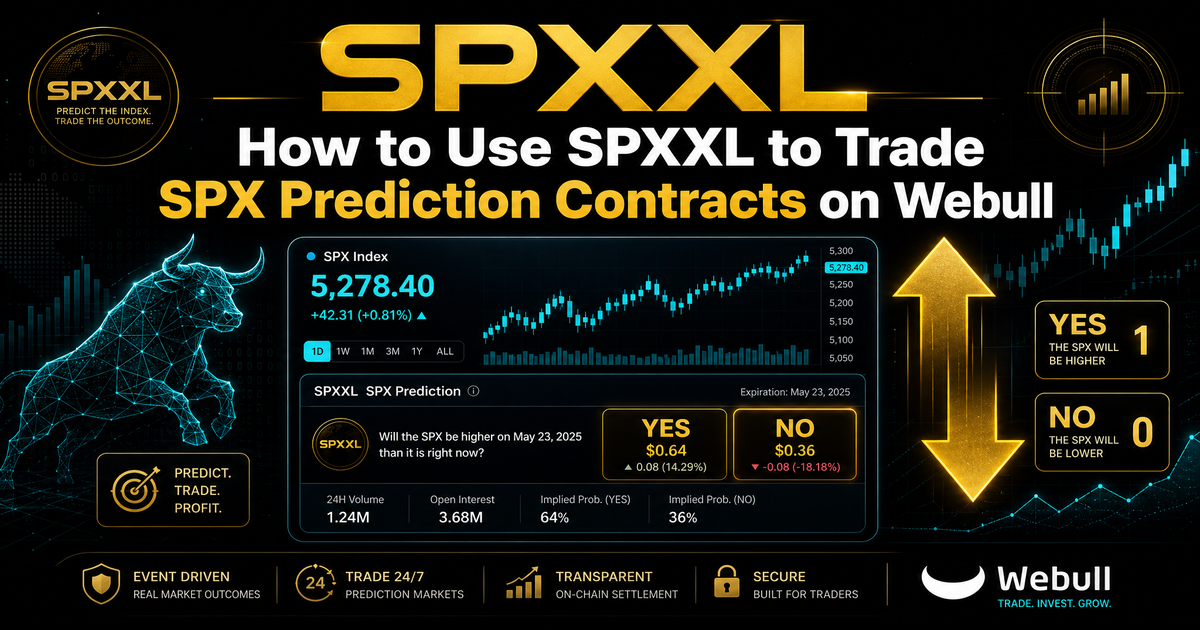
What Are SPX Prediction Contracts?
Webull now offers event contracts through Kalshi — a CFTC-regulated prediction market exchange. The concept is dead simple:
"Will the S&P 500 be above or below 5850 at 2:00 PM ET?"
You think ABOVE
Buy YES @ $0.65
Risk $0.65 → Win $1.00
You think BELOW
Buy NO @ $0.35
Risk $0.35 → Win $1.00
The contract price is the implied probability. A YES priced at $0.65 means the market thinks there is a 65% chance SPX finishes above that level. If you are correct at expiration, you receive $1.00. If wrong, the contract expires worthless.
Cost
$0.01–$0.99
per contract
Fees
$0.02
per trade
PDT Rule
None
no restrictions
No leverage, no Greeks, no spread construction — just a clean directional bet on SPX. Trading hours are 8:00 AM – 4:00 PM ET, and contracts settle hourly.
Why Most Prediction Traders Lose
Prediction contracts look simple. That is the trap. Here is why the average Webull user loses money on them:
- 1
They trade on vibes
SPX "feels" like it will go up, so they buy YES. No data, no framework, no edge.
- 2
They ignore the session regime
A Balanced Day session keeps SPX in a tight range. A Trend Day session runs directionally. The same strike picks produce wildly different outcomes depending on the regime — and most traders have no idea what regime they are in.
- 3
They pick bad strike levels
Buying a YES contract at $0.90 (90% implied probability) risks $0.90 to make $0.10. The payout math is terrible unless you are extremely confident — and confidence without data is just gambling.
- 4
They ignore time decay
As the hour progresses, the contract price converges rapidly toward 0 or 1. Entering too late means you are paying a premium for a binary outcome with almost no time to adjust.
The fix? Replace vibes with signals. That is exactly what SPXXL does.
The SPXXL Edge: 5 Signals That Matter
SPXXL was built as a real-time SPX session classification engine. It was designed for 0DTE options traders, but the signals map perfectly to prediction contracts. Here are the five signals that give you an edge on every hourly contract:
Session Classification
Know if the market is Balanced Day, Trend Day, Expansion Day, or Volatility Compression — each regime has a different above/below bias.
SPXXL Close Zone™
Projected price zone where SPX will close, updated every 30 seconds. Compare it to the strike level on Webull.
Regime & Confidence Score
0–100 confidence rating on the current session classification. Higher confidence = stronger signal.
Theta Decay Curve
Visualizes how quickly time value is eroding. Tells you whether to enter now or wait.
GEX Context (Gamma Walls)
Shows where dealer hedging creates support/resistance levels. If a gamma wall sits between price and the strike, SPX is unlikely to cross.
Signal #1 — Session Classification
SPXXL classifies every SPX trading session into one of six archetypes using a 7-dimension scoring engine. Each session type has a distinct behavioral fingerprint — and each one tells you something specific about prediction contracts:
SPX oscillates around VWAP in a range. Pick strikes near the boundaries — bet that SPX stays inside. Above/below contracts near VWAP are coin flips here.
SPX moves directionally all day. Buy YES (above) on bull trends, NO (below) on bear trends — especially if the trend started early.
Wide range, strong momentum. Avoid contracts with strikes in the middle of the range — price is moving away from VWAP and will likely stay extended.
Tight range, low volume. Price is coiling. Contracts near VWAP are safer; avoid far-from-VWAP strikes because the breakout has not happened yet.
Violent mechanical snap-back. Hard to predict timing. Reduce contract size or sit out — the move can overshoot in either direction.
Stop hunts followed by reversal. If a sweep just happened, bet on mean reversion back toward VWAP.
Before placing any prediction contract, check the SPXXL dashboard. If you do not know which session type you are in, you are already at a disadvantage.
Signal #2 — SPXXL Close Zone™
This is the highest-value signal for prediction contracts. The SPXXL Close Zone™ uses session classification, GEX walls, historical patterns, and time-decaying zone narrowing to project where SPX will close — updated every 30 seconds.
How to use it
Strike is inside the Close Zone™
The outcome is uncertain — SPXXL thinks SPX could land on either side of this level. Look for contracts with better pricing (mid-probability range, $0.40–$0.60) or skip.
Strike is below the Close Zone™
SPXXL projects SPX will close above this strike. Buy YES (above). The further below, the higher the conviction.
Strike is above the Close Zone™
SPXXL projects SPX will close below this strike. Buy NO (below). The further above, the higher the conviction.
The Close Zone™ narrows as the day progresses — by 2:00 PM ET, the projection window is typically very tight. This is when your conviction should be highest and your prediction contract bets most aggressive.
Signal #3 — Regime & Confidence Score
Every session classification comes with a 0–100 confidence score. This tells you how clearly the market fits the current archetype:
80–100
High Conviction
The regime is clear. Trust the session playbook. Size up your prediction contracts.
60–79
Moderate
The regime is forming but not dominant. Trade normal size. Use additional signals for confirmation.
Below 60
Low / Mixed
The session is transitioning or unclear. Reduce contract size or skip this hour entirely.
Simple rule: no trades below 60 confidence. This single filter eliminates most of the noise that blows up prediction contract accounts.
Signal #4 — Theta Decay Curve
SPXXL tracks theta decay — how quickly time value erodes from SPX options — in real-time. This matters for prediction contracts because hourly contracts behave the same way:
Early in the hour — contract prices are soft, implied probabilities reflect uncertainty, and you can get favorable entry prices on contracts the market has not fully priced.
Mid-hour — prices start converging. If your thesis is right, your contract is gaining value. Good time to exit partial positions for profit.
Late in the hour — binary convergence. Contracts are near $0 or $1. Entering here is high-risk — the outcome is almost decided, and you are paying a premium for certainty.
SPXXL's theta decay visualization shows you exactly where you are in this curve. Enter in the first 15 minutes of an hourly window when the market has not yet priced in the move.
Signal #5 — GEX Context (Gamma Walls)
Gamma Exposure (GEX) shows where dealer hedging creates invisible support and resistance levels. These gamma walls act like magnets and barriers for SPX price:
Positive GEX (Gamma Wall Above)
Dealers are selling into rallies → SPX is being pulled back toward the wall. If a prediction contract strike sits above a major positive gamma wall, SPX is unlikely to break through. Bet BELOW.
Negative GEX (Gamma Wall Below)
Dealers are buying into selloffs → SPX finds support at this level. If a prediction contract strike sits below a major negative gamma wall, SPX is unlikely to break below. Bet ABOVE.
When a gamma wall aligns with the SPXXL Close Zone™ projection, your conviction level should be at its maximum. Two independent signals pointing the same direction is the strongest setup.
Putting It Together: A Complete Trade
Here is a real-world example of how all five signals combine into a single prediction contract trade:
Scenario: 12:30 PM ET, Wednesday
Session type: Balanced Day (confidence: 84)
SPX price: 5847
SPXXL Close Zone™: 5840 – 5855
GEX wall: Positive gamma at 5860 (strong resistance)
Webull contract: "SPX above 5860 at 1:00 PM?" — YES @ $0.18
Analysis
- Balanced Day = SPX oscillates around VWAP, unlikely to extend far
- Close Zone™ tops out at 5855 — the 5860 strike is outside the projected range
- Positive gamma wall at 5860 = dealer resistance — SPX unlikely to break through
- 84 confidence score = high conviction in the Balanced Day regime
Trade
Buy NO (below 5860) @ $0.82 — risk $0.82 to make $0.18 profit per contract
The market is pricing YES at only 18% probability — and three independent SPXXL signals agree that SPX will not reach 5860. This is a high-probability trade with a data-backed thesis.
Prediction Contracts vs 0DTE Options
If you already trade 0DTE SPX options, you might wonder why you should care about prediction contracts. Here is how they compare:
| Feature | Prediction Contracts | 0DTE Options |
|---|---|---|
| Complexity | Simple (above/below) | Complex (Greeks, strikes, spreads) |
| Max Risk | Contract price ($0.01–$0.99) | Spread width or premium paid |
| Leverage | None | Significant (delta, gamma) |
| PDT Rule | No | No (SPX index options) |
| Fees | $0.02/contract | $0.65/contract (typical) |
| Min Account | No minimum | $2,000+ recommended |
| Profit Potential | Capped at $1.00/contract | Unlimited (long calls/puts) |
| Best For | Directional conviction bets | Structured risk/reward strategies |
| SPXXL Utility | ✅ Full signal stack applies | ✅ Full signal stack applies |
Bottom line: prediction contracts are a simpler instrument for the same directional thesis. If you are already an SPXXL user trading 0DTE options, prediction contracts give you a second instrument to express your views — especially useful for smaller account sizes or when you want a simple binary bet without spread mechanics.
The Rules: Risk Management for Prediction Contracts
Prediction contracts feel safe because the max loss is the contract price. But they can still drain your account fast if you are reckless. Here are the rules:
Never risk more than 5% of your account per hourly window
If your account is $5,000, max $250 in contracts per hour. This survives a string of losses.
Only trade when confidence is 60+
SPXXL's confidence score exists for a reason. Low confidence = sit on your hands.
Avoid contracts priced above $0.85 or below $0.15
At $0.90, you risk $0.90 to make $0.10. At $0.10, the market is giving you 10% odds for a reason. The sweet spot is $0.30–$0.70.
Enter in the first 15 minutes of the hourly window
Early entry gives you time for the thesis to play out. Late entry is chasing.
Take profits at 50%+ of max gain
If you bought at $0.35 and it is at $0.70, you have doubled your money. Take it. Do not wait for $1.00 — the last $0.30 carries the most risk.
Max 3 hourly windows per day
Overtrading kills. Pick the 2–3 best setups — usually 10:00 AM, 12:00 PM, and 2:00 PM windows when SPXXL signals are clearest.
Skip Short Covering and low-confidence sessions
If SPXXL classifies the session as Short Covering or confidence drops below 60, close Webull and do something else.