
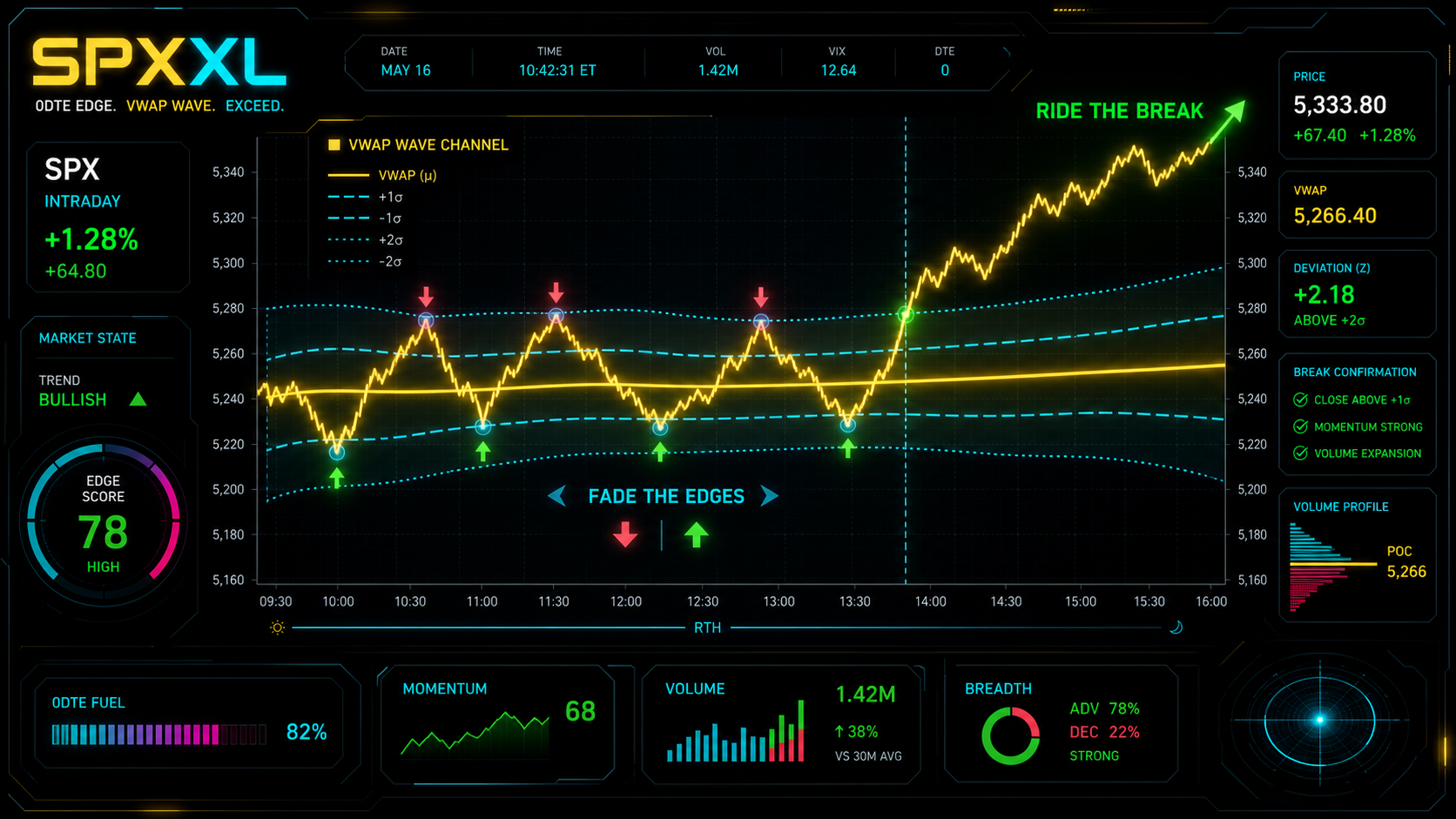
The Whole System on One Chart
The VWAP-wave method rests on a single instrument: VWAP with standard-deviation bands. VWAP (the volume-weighted average price) is the day's fair-value anchor. Draw a band one standard deviation above it and one below, and you have carved out the value area — the zone where the great majority of the day's trading happens.
When price sits inside the value area, the market is Balanced — comfortable, rotating, two-sided. When price breaks outside the bands and stays there, the market has entered price discovery — it is moving, Trending, hunting for a new level. That is the entire market-read: balance or discovery.
The Only Question That Matters at 9:30
Every morning the framework asks one question: is price inside the bands, or outside with acceptance? Answer that and your whole posture for the day is decided — you are either a fade trader or a trend trader. You do not have to guess which.
This is precisely the read SPXXL was built to hand you. Instead of you squinting at bands, the engine classifies the SPX session into one of six types and shows it at the top of your dashboard. The mapping to the VWAP wave is almost one-to-one:
- Balanced Day (and Volatility Compression / Liquidity Sweep) → balance conditions → you are fading the edges.
- Trend Day / Expansion Day → discovery conditions → you are riding the break.
Two more instruments make the Call concrete. The Mean Reversion score (0–100) tells you how strongly the day is rotating back to value, and the new Systematic Bias chip tells you whether price is stacked above VWAP (favor longs) or below it (favor shorts). Together they answer the morning question before you place a single order.
Condition 1 — Balance: Fade the Edges
On a Balanced Day price rotates around VWAP: it stretches to the upper band and gets sold back, drops to the lower band and gets bought back. The classic play is to fade the edge back toward VWAP. Price tags the top band, you lean short; price tags the bottom band, you lean long; the target is the VWAP centerline.
Here is how that translates into your structures instead of futures scalps:
The whole-day fade: a Debit Condor
If SPXXL reads a Balanced Day with a high Mean Reversion score and a ✓ REVERSION TAILWIND badge, the cleanest expression is to fade both edges at once. Build a Debit Condor with the inner (sold) strikes parked around the ±1σ band / Expected Move rails and the long protective wings further out, then let price rotate inside the value area while theta tightens your win zone. You are not predicting direction — you are betting the day stays Balanced, which is exactly what “inside the bands” means.
The single-edge fade: a VWAP-target debit spread
Prefer to trade one touch at a time? When price stretches to the upper ±2σ band on a reverting day, buy a tight bear Put debit spread with the long leg near price and the short leg near VWAP — your target is the snap-back to the centerline. When price tags the lower band, flip it: a bull Call debit spread targeting VWAP. Defined risk, and the VWAP centerline is your natural profit-take.
The pin play: a Butterfly at VWAP
When the Mean Reversion score is high and a Price Magnet is sitting right on VWAP, a Butterfly centered at the VWAP / value pin captures the “everything returns to fair value” thesis with a small, defined debit and a fat payout if price finishes near the anchor.
Condition 2 — Discovery: Ride the Break
Now the market shifts. Price breaks outside the bands and stays there — multiple candles, time building. That is acceptance, and it flips you out of fade mode and into trend mode. You stop fighting the move and start trading with it: buy pullbacks to the band on an upside break, sell rallies to the band on a downside break.
The same tags that were fade signals a moment ago now become continuation signals. Your options translation:
Upside discovery: a Bull Call debit spread
Price accepts above the bands, SPXXL flips to a Trend / Expansion Day, and the Systematic Bias chip turns GREEN (price stacked above VWAP + 9-EMA + 50-MA). Buy a bull Call debit spread on the pullback to the band rather than chasing the high — the band is your low-risk entry, the next projected level is your target. Want raw convexity? A single SPX Call works when the move is fresh and momentum is strong.
Downside discovery: a Bear Put debit spread
Price accepts below the bands, the session reads Trend down, and the Systematic Bias chip turns RED. Buy a bear Put debit spread on the bounce back to the band — or a single SPX Put for a clean directional shot. You are riding discovery lower, not catching the falling knife by fading it.
Rule 3 — The Middle Is a Trap
The third rule is the one that saves accounts: do not trade the middle of the bands. The edges are where probability lives — a stretched band tag is a 70–80% context. The dead center is a coin flip. Trade it and you are guessing.
SPXXL enforces this for you in two places. The Edge Score drops into its Stand Aside zone when the read is muddy, and the Systematic Bias chip prints NEUTRAL when price is mid-stack — neither cleanly above nor below the MA stack. When you see either, the correct SPX trade is no trade. Sit on your hands, keep your capital, and wait for price to reach an edge or for a break to earn acceptance.
Your SPXXL VWAP-Wave Cheat Sheet
Tape this to your monitor. It is the entire framework mapped to what your dashboard is already showing you and the structure that fits each state:
The Math: Why Bigger Winners Beat a High Win Rate
The VWAP-wave edge is not a magic win rate — it is asymmetry. If your winners are meaningfully larger than your losers, you can be right well under half the time and still come out ahead. The framework's own example: win about three points, cut losers at two, and you only need to be right ~40% of the time to make money.
For an options trader that principle maps straight onto risk-defined structures. A debit spread hands you a fixed max loss and a fixed max profit before you enter — so you can engineer the payoff ratio deliberately. The discipline is identical to the futures version: let the winners run to the target, cut the losers fast, and never let a small defined-risk loss turn into a full max-loss just because you “felt” it would come back.
Mistakes That Sink the Wave
- Fading a discovery day. Selling Condors or fading the edge while price is accepting outside the bands is fighting a trend. When SPXXL flags REVERSION VS TREND, the fade book is closed — go directional or stand aside.
- Trading the middle. A mid-band, NEUTRAL-bias, Stand-Aside read is a no-trade, full stop. The middle is where accounts bleed a thousand small guesses.
- Chasing the break instead of the pullback. On discovery days the low-risk entry is the pullback to the band, not the candle that just ran. Let price come back to you; the band is your entry.
- Holding losers, cutting winners. The whole edge is winners > losers. Take the VWAP target on your fades, let your trend spreads reach the projected level, and cut a wrong-way debit spread before it hits full max loss.
Let SPXXL Answer the Morning Question for You.
Balance or discovery? Fade or ride? SPXXL classifies the SPX session, scores the reversion, gates the bias, and draws the bands — so you show up knowing exactly which VWAP-wave playbook is live today.
Disclaimer: Options trading involves substantial risk of loss and is not suitable for all investors. This article is educational and uses SPX for illustration only — it is not financial advice, a signal, or a recommendation to buy or sell any security. The VWAP-wave framework described here is a third-party trading concept adapted for illustration; SPXXL is not affiliated with its originators. Examples are simplified and do not account for commissions, fees, bid-ask spreads, slippage, or real-world execution. SPXXL provides analytical tools and session classification as decision support only — not guaranteed outcomes. 0DTE options can lose their entire value in a single session. Always trade with capital you can afford to lose and consider consulting a licensed financial advisor.