
What Is a Condor? (The ThinkorSwim Way)
If you've ever looked at the SPX and said, "I think the market is going to close somewhere between here and here,"then congratulations — you already think like a Condor trader.
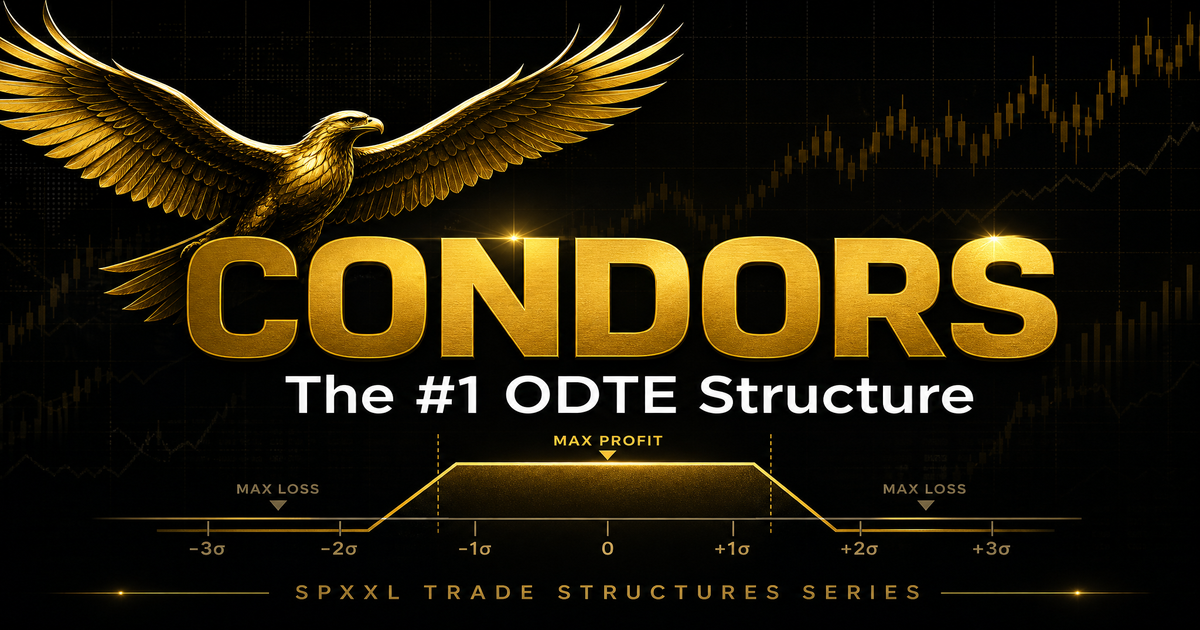
A Condor is a four-legged options structure where you're betting SPX will land inside a specific range at expiration. In ThinkorSwim, when you select "Condor" from the spread builder, it creates:
The 4 Legs of a Condor (Debit)
Transaction type: Buy To Open (all 4 legs at once) → Sell To Close whenever you're ready to take profit.
The two sold strikes in the middle are your golden zone. If SPX closes anywhere between those two strikes at expiration, you collect maximum profit. The two outer bought strikes are your seat belts — they cap your risk on both sides.
Why Condors — Not Iron Condors
Here's where most people get confused. Let me make this crystal clear:
❌ Iron Condor (Credit)
You sell the structure. You collect a premium. You're hoping it expires worthless. Your max profit is capped at the credit, but your max loss is the width of the wings minus the credit. You're on defense from the start.
✅ Condor (Debit) — What I'm Doing
You buy the structure. You pay a small debit. Your max loss is limited to what you paid. Your max profit happens when SPX lands inside your two sold strikes. You're on offense — you chose the range, you chose the bet.
I find debit Condors easier to teach beginners because the risk is simple: you can only lose what you paid. No margin surprises. No scary undefined risk. Just a clean, defined bet.
The Anatomy: 4 Legs, 1 Simple Bet
Think of the Condor like a target range on a football field:
The wider your middle zone (between the two sold strikes), the more likely you win — but the more you pay upfront.That's the tradeoff. And on a Balanced Day, the math tips heavily in your favor.
Why Balanced Days Make Condors a Cheat Code
This is the part that changed everything for me. Pay attention.
The Balanced Day Advantage
- Most SPX days are Balanced Days. Historically, Balanced Day sessions make up the majority of trading days. The market isn't Trending or exploding — it's chopping, rotating, and mean-reverting inside a range.
- Condors are built for range. When the market stays inside a range, your Condor wins. Balanced Days = range-bound = Condor paradise.
- You don't need to predict direction. Bull or bear doesn't matter. You just need SPX to close inside your two middle strikes. On a Balanced Day, it usually does.
- Theta works for you. As the day progresses, time decay erodes the outer wings faster than the inner body. Your Condor gains value as the clock ticks — without SPX doing anything at all.
When you combine the fact that most days are Balanced Days with a structure that profits from range, you've just stacked the deck in your favor. That's not gambling. That's math.
How SPXXL Gives You the Perfect Range
The hardest part of a Condor is deciding: "Where do I set my range?" This is where SPXXL removes the guesswork.
Session Classification
SPXXL tells you it's a Balanced Day before you even place the trade. If it says Trend Day or Expansion Day — you skip the Condor entirely. No guessing.
Close Zone™ Projection
The Close Zone™ widget narrows down WHERE SPX will likely close — updated every 30 seconds. Place your sold strikes outside the projected range for maximum safety.
ADR Levels & IB Extensions
Average Daily Range and Initial Balance extensions give you the statistical boundaries. Your outer wings can sit right at these levels — mathematically unlikely to be breached on a Balanced Day session.
GEX Walls
Gamma Exposure walls show where dealer hedging creates support/resistance. These are natural barrier levels. Your sold strikes can lean on these walls like guardrails.
With these indicators on your chart, you're not throwing darts blindfolded. You're reading the map before you place the bet. That's the SPXXL edge.
A Real Trade Example — Step by Step
Let's walk through a Condor on a textbook Balanced Day. I'll keep it dead simple.
Condor Trade Setup
Market context: SPX at 5800. SPXXL classifies the session as Balanced Day. Close Zone™ projects 5775–5825. GEX walls at 5760 and 5840.
Time: 10:45 AM ET — session type confirmed, IB formed.
Net Debit: ($2.80 + $2.50) − ($6.50 + $6.20) = $7.40 credit... wait.
💡 Wait — let me clarify the math
When ThinkorSwim builds this as a "Condor" with all legs entered as a single package via Buy To Open, the net result is a debit you pay. The platform nets the premiums for you. Your debit might be something like $3.00–$6.00 per contract ($300–$600).
Max Profit: Width of inner spread minus debit paid. If your two sold strikes are 60 points apart and you paid $3.00 debit, your max profit at expiration (SPX between 5770–5830) is approximately $17.00 ($1,700 per contract).
Max Loss: The debit you paid — $3.00 ($300 per contract). That's it. That's the worst case.
Risk-to-reward ratio: ~1:5. You're risking $300 to potentially make $1,700. On a Balanced Day session. Where the market barely moves. 🤯
Theta Farming: The Art of the Harvest
Here's the secret weapon that makes Condors even more addicting: you don't have to wait until expiration.
As the day progresses and SPX stays inside your range, theta decay does its thing. Your Condor's value increases. You can Sell To Close at any time to lock in profits.
🌾 The Theta Harvest Timeline
Trade placed. SPX inside range. Theta just starting.
Midday. If still in range, theta has done meaningful work.
Theta acceleration zone. Many traders cash out here.
Deep theta. Great exit point — risk/reward shifts.
Terminal zone. Max profit approaches but gamma risk spikes.
I call this "Theta Farming" — you plant the Condor in the morning, let theta water it through the day, and harvest whenever you're comfortable with the yield. No need to hold until expiration. No need to be greedy.
When to Cash Out
This is the part where discipline makes you money. My personal rules:
Take 40–60% and walk away.
If your Condor is up 50% before 1 PM, close it. That's a great day. Don't get greedy.
Never hold past 3:00 PM.
Gamma risk spikes in the terminal zone. A Balanced Day can turn into a breakout in the final hour. Protect your profits.
If session type changes, exit immediately.
SPXXL classifies in real-time. If Balanced Day shifts to Trend Day or Expansion Day, your Condor is in danger. Sell To Close and live to trade tomorrow.
Cash out if you hit your daily target.
Have a daily P&L goal. Hit it? Done. Close ThinkorSwim. Go live your life.
Risk Management — What Can Go Wrong
Condors aren't invincible. Here's what can break them:
- Trend Days. If SPX decides to run 60+ points in one direction, your Condor gets obliterated on one side. That's why you only trade Condors on Balanced Day sessions.
- News bombs. Unexpected Fed comments, surprise economic data — these can break any range. Check the economic calendar before trading.
- Holding too long. Gamma risk in the final hour can turn a winner into a loser in minutes. Always have a time-based exit.
- Too narrow a range. If your sold strikes are too close together, even normal market rotation can threaten your position. Wider is safer — SPXXL's indicators help you find the right width.
The Golden Rule: Your max loss on a Condor is the debit you paid. Know that number before you enter. If you're not comfortable losing it, trade smaller.
Why This Is My #1 Structure
Let me lay it out plainly — why I fell in love with Condors and never looked back:
You're betting on a RANGE, not a direction. Most days, the market stays in a range.
The risk-to-reward is absurd. Risk $300 to make $1,500+? Sign me up.
Theta works for you all day. You're getting paid to wait.
Low stress. You're not watching every tick. Set it, monitor it, harvest when ready.
SPXXL tells you WHEN it's safe. Balanced Day confirmed? Condor time.
Max loss is always defined. Always. You can never lose more than the debit.
Repeatable. Same process, every Balanced Day. It's a system, not a gamble.
"On a Balanced Day, the Condor isn't a bet.
It's a harvest."
— The SPXXL Philosophy