
1. Why Risk Management Is Different for 0DTE
0DTE options are not just “fast options.” They operate under fundamentally different physics than multi-day positions. Understanding why risk management must change is the first step to surviving.
The 0DTE Risk Multipliers
- • Gamma is king: Delta changes rapidly with every tick. A position that was 10-delta at open can become 40-delta within an hour.
- • Theta accelerates non-linearly: Time decay isn’t linear — it follows a curve that steepens dramatically after 1:00 PM ET.
- • No overnight recovery: Unlike multi-day positions, there’s no “it might come back tomorrow.” Every loss is realized today.
- • Rapid feedback loops: The daily P&L cycle creates emotional pressure that can lead to revenge trading and overtrading.
- • Liquidity shifts: Bid-ask spreads can widen significantly in the final 30 minutes as market makers reduce exposure.
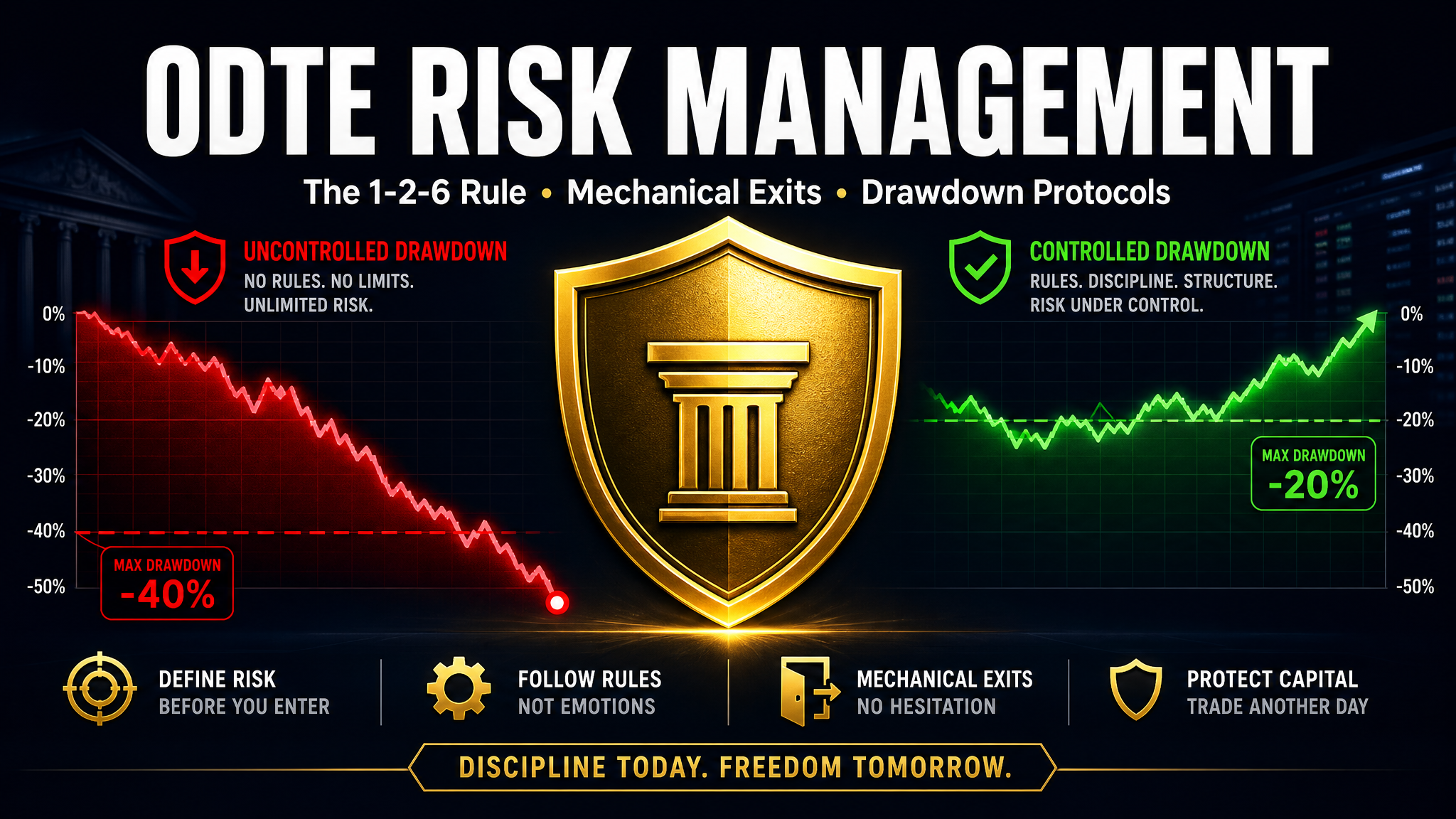
Because of these dynamics, position sizing and exits matter more than entries. A mediocre entry with excellent risk management will outperform a perfect entry with poor risk management every time.
2. The 1-2-6 Position Sizing Framework
Professional 0DTE traders use a tiered position sizing framework that adjusts exposure based on conviction and session classification. I call it the 1-2-6 rule.
Per-Trade Risk
Never risk more than 1% of your account on any single 0DTE trade. On a $50,000 account, that’s $500 max loss per position.
Daily Risk Cap
Cap total daily risk at 2% of account. After two full losses, you’re done for the day. No exceptions. No “one more trade.”
Weekly Drawdown Limit
If cumulative weekly losses hit 6%, stop trading for the remainder of the week. Reset Monday. This prevents catastrophic streaks.
This framework ensures that even a string of bad days cannot destroy your capital. A trader following 1-2-6 can survive 30 consecutive losing days and still have 74% of their account intact.
SPXXL calculates your optimal position size based on account value, current volatility regime, and session classification — adjusting automatically so you don’t have to do the math in real-time.
3. Defined-Risk Structures Only
Rule #1 of 0DTE risk management: never trade naked options. Every position must have a defined maximum loss known before entry.
Approved 0DTE Structures
Your debit paid IS your max loss — that is the beauty of Debit Spreads. A $5.00 debit means $500 max risk. A $2.50 debit means $250 max risk. Match your debit amount to your 1% per-trade risk budget.
4. Mechanical Exit Rules
Discretionary exits kill 0DTE traders. The speed of gamma-driven P&L swings triggers emotional decisions. Instead, pre-commit to mechanical rules before every trade.
The Exit Framework
Write these rules on a sticky note next to your screen. When your position is under pressure and adrenaline is flowing, you will not think clearly. The rules think for you.
5. Event Day Adjustments
Not all trading days are created equal. Certain events inject outsized volatility that breaks normal session patterns. On these days, your risk management must adapt.
High-Impact Events
- • FOMC Announcements (8× per year): Reduce position size by 50% or sit out entirely. The 2:00 PM ET announcement creates a binary outcome that no spread width can adequately protect against.
- • CPI / Jobs Reports (monthly): Pre-market data releases cause gap opens. Wait for the initial balance to form (first 30 minutes) before entering. Widen your strikes by 20%.
- • Quad Witching (4× per year): Expiration of multiple derivatives creates erratic flows. Liquidity shifts unpredictably. Consider sitting out or trading minimum size.
- • VIX above 25: When VIX exceeds 25, session classification reliability drops. Reduce size to 50% and only trade directional Debit Spreads (no Debit Condors — the range is too unpredictable).
SPXXL’s session classification engine automatically flags event days and adjusts its recommendations. On days when sitting out is the optimal play, the system tells you — which is the hardest edge of all.
6. Drawdown Management Protocol
Every trader experiences drawdowns. The difference between professionals and amateurs is having a protocol for managing them — not a feeling, but a system.
The Drawdown Ladder
This ladder is non-negotiable. The traders who survive long enough to become profitable are the ones who protect their capital during losing streaks. You can always make back money, but you can’t trade without capital.
7. The Risk Management Checklist
Before every 0DTE trade, run through this checklist. It takes 30 seconds and prevents 90% of avoidable losses.
Print this. Laminate it. Use it every single trade until it becomes automatic. The traders who skip checklists are the ones who email me asking why they blew up.
8. Building the Risk Management Mindset
The most dangerous moment in 0DTE trading is when you start having consistent winners. Confidence becomes overconfidence. Position sizes creep up. Rules get bent. Then one session wipes out three weeks of gains.
Risk management is not about avoiding losses. It’s about ensuring that losses remain small, controlled, and non-threatening to your overall capital. Every professional trader loses — the difference is how much they lose when they’re wrong.
The Professional Trader’s Mantras
- “I don’t need to trade today. The market will be here tomorrow.”
- “My job is not to make money — it’s to manage risk. Money is the byproduct.”
- “If I follow my rules, today’s outcome is irrelevant. The edge plays out over hundreds of trades.”
SPXXL was built on this philosophy. Every feature — session classification, excursion tracking, the implied order book, position sizing guidance — exists to help you trade with discipline, not with emotion.