
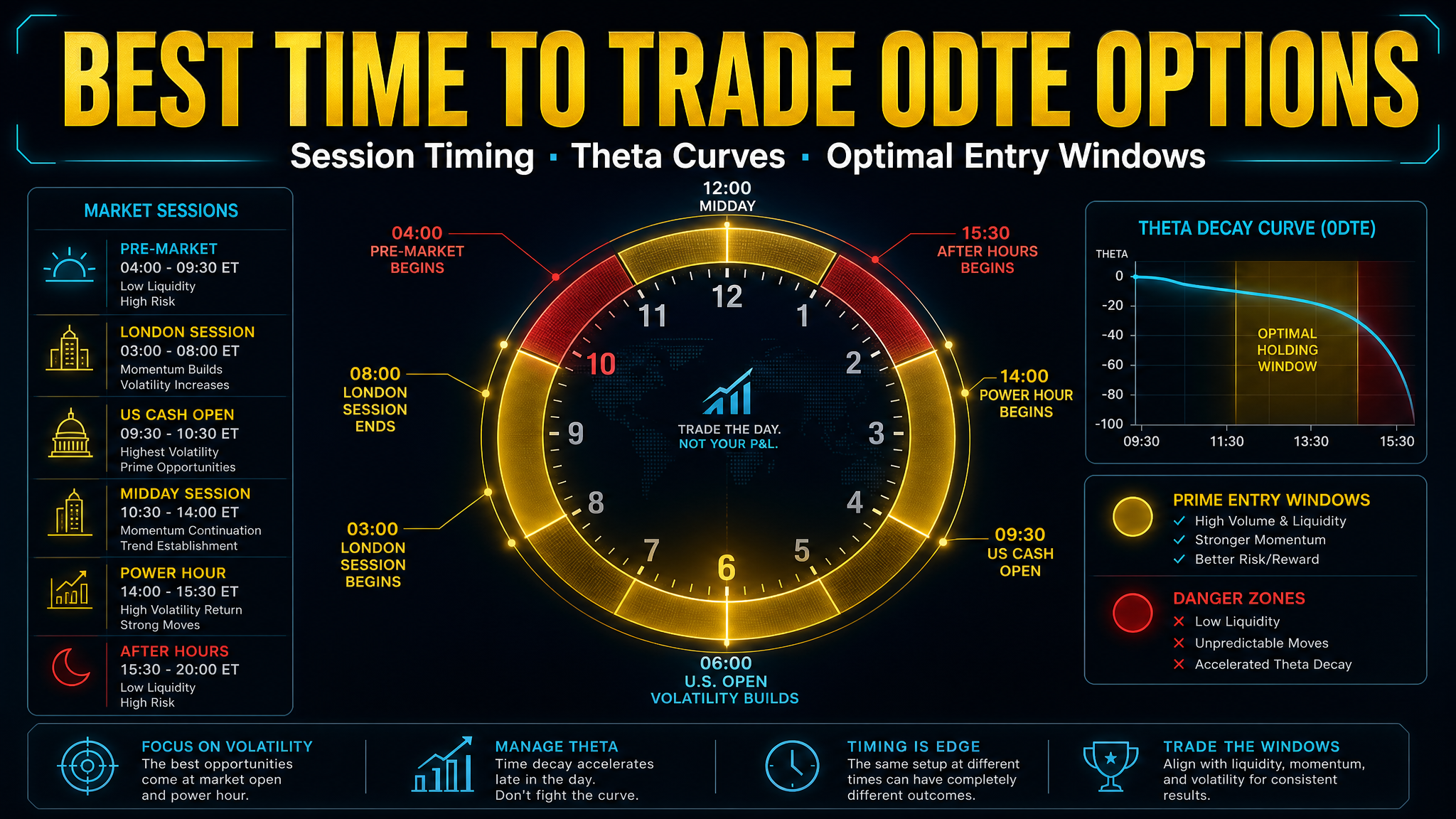
1. The 0DTE Trading Day Anatomy
A 0DTE trading day is not a single event — it’s a series of distinct sessions, each with different volatility characteristics, liquidity profiles, and risk/reward dynamics. Professional traders don’t just trade 0DTE; they trade specific windows within the 0DTE session.
Understanding these windows is the difference between harvesting theta efficiently and fighting gamma in the worst possible conditions.
Key Principle
Theta decay is not linear. It follows a curve that accelerates through the day. The shape of this curve — and how gamma interacts with it — determines when the risk/reward is best for each strategy type.
2. Pre-Market (Before 9:30 AM ET)
You can’t trade 0DTE options pre-market, but what happens before the bell sets the tone for the entire session.
Pre-Market Checklist
This preparation takes 10-15 minutes and is worth more than any single trade you’ll take during the day.
3. The Opening Range (9:30–10:00 AM ET)
The first 30 minutes are the most dangerous period for 0DTE traders. Volatility is at its daily peak. Spreads are wide. Gamma is extreme. Institutional order flow creates whipsaw price action.
Professional Recommendation: Avoid
Most professional 0DTE traders do not trade the opening 30 minutes. The bid-ask spreads are widest, gamma is most volatile, and the session type hasn’t been classified yet. You’re trading blind into maximum uncertainty.
Exception: If you’re an experienced trader with a specific opening drive thesis (based on pre-market analysis), directional Debit Spreads can work during this window. But for range-capture Debit Condors — which is what most 0DTE traders run — the opening range is a trap.
4. Initial Balance Formation (10:00–11:30 AM ET)
The initial balance (IB) is the price range established between approximately 10:00 AM and 11:30 AM ET. This range is critical for session classification — it tells you what kind of day you’re likely dealing with.
Narrow IB (Balanced Day)
If the IB range is narrow relative to the expected move, you’re likely in a Balanced Day, mean-reverting session. Debit Condors and Debit Butterflies thrive here.
Wide IB (Trend Day)
If the IB has already consumed most of the expected move, the session may trend. Directional Debit Spreads with the trend work best.
This is the reconnaissance period. You’re not necessarily trading yet — you’re gathering intelligence. SPXXL’s session classification engine uses this window to categorize the day and recommend the optimal structure.
Some aggressive traders place their first trades during this window, using the developing IB as context. If you do, keep position sizes at 50% of normal until the IB is confirmed.
5. The Core Theta Window (11:30 AM–2:00 PM ET)
This is the sweet spot for 0DTE Debit Condor traders. The session type has been classified, the initial balance is established, and theta decay is accelerating.
Why This Window Works
- • Theta accelerates: The decay curve steepens noticeably after 11:30 AM. Premium erodes faster than in the morning.
- • Volatility compresses: After the opening volatility and IB formation, midday tends toward lower realized volatility (unless it’s a Trend Day/Expansion Day).
- • Session type confirmed: By now, the IB is set and you know whether you’re in a Balanced Day, Trend Day, or Expansion Day environment.
- • Institutional lunch lull: Many institutional desks reduce activity during midday, creating calmer, more predictable conditions.
Most professional 0DTE traders place their primary trades during this window. The data supports it: on Balanced Day sessions, Debit Condors opened between 11:30 AM and 1:00 PM ET have the highest win rate, because the session type is already confirmed and the range is well-defined.
Caveat: On FOMC days, the 2:00 PM announcement changes everything. Close positions or reduce size before 1:45 PM on announcement days.
6. Power Hour Setup (2:00–3:00 PM ET)
The period from 2:00–3:00 PM is complex. Theta is decaying rapidly, which tightens a Debit Condor’s win zone — but gamma is also increasing, which creates danger if the underlying moves.
The 2:00–3:00 PM Trade-Off
- • Theta decay at ~60% of daily rate
- • Premium has already eroded significantly
- • Profit targets are closer to being hit
- • Gamma sensitivity intensifying
- • Delta shifts faster with each tick
- • New money-on-close orders entering
If you have existing positions from the core theta window, this is the period to manage, not initiate. Monitor your positions. If you haven’t hit your profit target yet but are at 50%+ of max profit, consider closing — the incremental theta gain isn’t worth the gamma risk.
The exception is if the session is extremely calm and Balanced Day. In those rare cases, you can open small positions during this window to capture the last burst of accelerated decay.
7. The Terminal Zone (3:00–4:00 PM ET)
The final hour of 0DTE trading is the most misunderstood. Theta is at its absolute maximum, which makes it seem like the best time to enter range trades. But gamma is also at its maximum, and liquidity is deteriorating.
Terminal Zone Dangers
- • Gamma explosion: A 1-point move in SPX can flip a 10-delta option to 50-delta in minutes.
- • Bid-ask widening: Market makers widen spreads to compensate for pin risk and gamma exposure.
- • Pin risk: If SPX is near a major strike at expiration, unpredictable hedging flows create erratic moves.
- • MOC imbalances: Market-on-close orders can push SPX 5-10 points in the final minutes.
The professional approach: Be out of all 0DTE positions by 3:30 PM ET. The incremental theta captured in the final 30 minutes is not worth the catastrophic gamma risk. Set a time stop at 3:30 PM and honor it without exception.
The only traders who operate in the 3:30-4:00 PM window are market makers with hedged books and institutional desks managing expiring positions. If that’s not you, be done for the day.
8. The Theta Decay Curve by Time
Here’s how theta decay distributes across the 0DTE trading day. This curve is approximate and varies by volatility regime, but it illustrates why timing matters so much:
Hourly Theta Distribution (Approximate)
The key insight: 52% of total daily theta decays between 11:30 AM and 2:30 PM. This is why the core theta window is the professional’s primary trading zone — you capture the majority of decay with significantly less gamma risk than the final hour.
9. Session Timing by Strategy
Different strategies have different optimal windows. Match your strategy to the right time of day:
10. Putting It All Together
Your ideal 0DTE day should look something like this:
This schedule means you’re actively trading for only about 2-4 hours per day. That’s by design. The best 0DTE traders are patient, selective, and disciplined about when they engage — not just what they trade.