
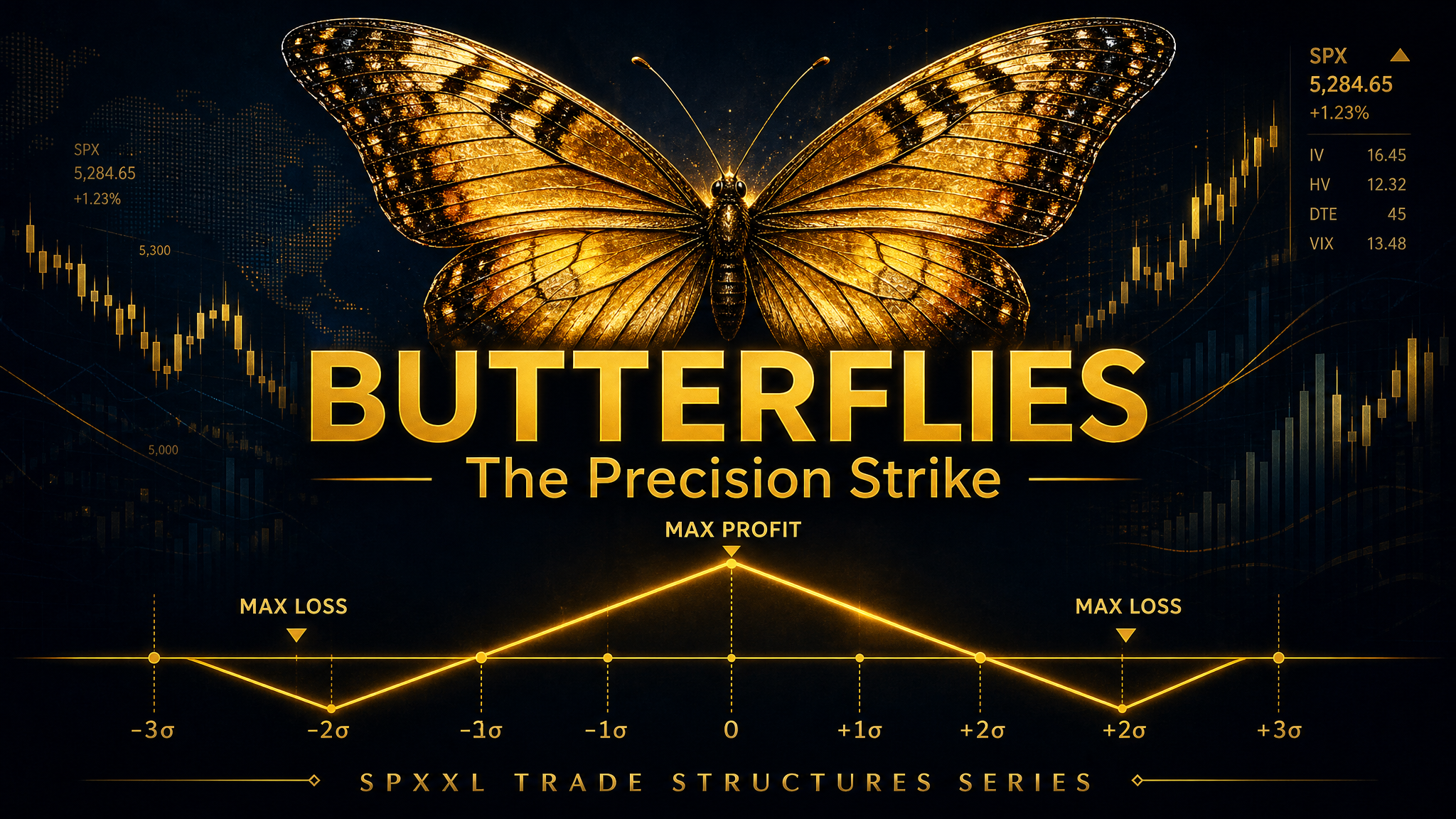
What Is a Butterfly? (The Long Debit Butterfly)
A Butterfly is the simplest expression of a belief: "I think SPX will close right HERE."Not somewhere in a range. Not above or below a level. Right. Here.
In ThinkorSwim, when you select "Butterfly" from the spread builder, it creates a beautifully symmetrical three-strike structure:
The 3 Legs of a Long Debit Butterfly
Transaction type: Buy To Open (all 3 legs at once). Ratio is always 1–2–1. You can use all Calls, all Puts, or mix — the payoff is the same.
The two sold options at the center strike are where the magic happens. If SPX closes exactly there, those sold options expire worthless to the buyer, and your long wings capture maximum value. Your debit was tiny. Your payout is huge.
Butterfly vs Condor — Same Family, Different Weapon
In the Trade Structures Series, the Condor was #1. The Butterfly is #2. They're related — but serve very different purposes:
🦅 Condor — The Net
You cast a wide net. You win if SPX closes anywhere inside a range between your two inner strikes. Forgiving. Higher probability. More moderate reward. Best for: "I know it's a Balanced Day, and the range is roughly here."
🦋 Butterfly — The Sniper
You aim for one point. You win the most if SPX closes exactly at your center strike. Less forgiving. Lower probability. Massively higher reward. Best for: "SPXXL Close Zone™ says SPX closes at 5810. I believe it."
Side-by-Side Comparison
Here's the key insight: SPXXL's Close Zone™ projection turns the Butterfly from a low-probability gamble into a high-conviction precision trade. Without a targeting system, a Butterfly is a lottery ticket. With Close Zone™, it's a guided missile.
The Anatomy: 3 Strikes, 1 Precision Bet
The Butterfly payoff diagram is iconic — the "tent" shape everyone has seen but few truly understand:
The closer SPX closes to your center strike, the more you make.At exactly the center? Maximum profit. At the wings? Maximum loss (your debit). Anywhere in between? Proportional profit — like a sliding scale up the sides of the tent.
This is why I call it the "Precision Strike." You don't need a range. You need a target. And the SPXXL Close Zone™ gives you exactly that.
Why Butterflies Are a Cheat Code With Close Zone™
This is the section that will change how you think about 0DTE trading forever. Read it twice.
The Close Zone™ × Butterfly Edge
- Close Zone™ tells you WHERE. It projects the most probable closing price of SPX — updated every 30 seconds, refined as the day progresses. That projection IS your center strike.
- Session Type tells you WHEN. Balanced Day and Volatility Compression sessions have the tightest Close Zone™s. When SPXXL classifies the session, it's telling you whether a Butterfly has a high-probability setup or not.
- The zone narrows as the day ages. At 10 AM, the Close Zone™ might be 30 points wide. By 1 PM, it's 10 points. By 2:30 PM, it's 5 points. The later you wait, the more precise the target — and the cheaper the Butterfly.
- You're not guessing. You're guided. Without Close Zone™, a Butterfly is a lottery ticket. With it, you're deploying a guided missile to a GPS coordinate. That's the difference between gambling and trading with an edge.
I used to think Butterflies were too risky — too dependent on getting the exact price right. Then I started using Close Zone™ as my targeting system. My hit rate went from "occasionally lucky" to "consistently profitable."The tool doesn't guarantee a win. But it gives you an aim that most traders simply don't have.
The Math That Will Make You a Believer
Let me walk you through the numbers that made me fall in love with this structure:
💰 Butterfly Economics 101
You Pay (Debit)
$0.50–$2.00
per contract ($50–$200)
You Can Win
$5.00–$15.00+
per contract ($500–$1,500+)
With a 10-wide Butterfly (strikes 10 points apart), your max profit is $10.00 per contract minus the debit. If you paid $1.00, your max is $9.00. That's a 9:1 reward-to-risk ratio.
With a 5-wide Butterfly (strikes 5 points apart), your max profit is $5.00 minus debit. Paid $0.50? Max is $4.50. That's a 9:1 ratio again.
And here's the beautiful part: you don't need to hit the exact center to make money.SPX just needs to close within your two wings. The closer to center, the bigger the payout. Even closing 3 points away from your center still yields 70%+ of max profit.
Think about it: risk $100 to make $900. And you have a tool telling you exactly where to aim. This is why I said it would make you a believer.
A Real Trade Example — Step by Step
Let's walk through a textbook Butterfly on a Balanced Day session using SPXXL. Every step.
Butterfly Trade Setup
Market context: SPX at 5808. SPXXL classifies as Balanced Day. Confidence: 78%. Close Zone™ projects 5810 ± 6 pts. GEX walls at 5790 and 5830.
Time: 11:30 AM ET — IB confirmed, session type locked in, Close Zone™ narrowing fast.
Decision: Close Zone™ says 5810. That's my center strike. I'll build a 10-wide Butterfly.
Net Debit: ($12.50 + $3.00) − $14.00 = $1.50 ($150 per contract)
Max Profit: $10.00 − $1.50 = $8.50 ($850 per contract) — if SPX closes at 5810
Max Loss: $1.50 ($150 per contract) — if SPX closes below 5800 or above 5820
📊 How the Day Plays Out
12:30 PM: SPX at 5812. Close Zone™ now says 5809 ± 4 pts. Your Butterfly is worth $2.80. You're up 87%.
2:00 PM: SPX drifts to 5808. Close Zone™ says 5810 ± 3 pts. Butterfly worth $5.20. You're up 247%.
3:00 PM: SPX at 5811. Close Zone™ pinpointing 5810 ± 2 pts. Butterfly worth $7.50. You're up 400%.
You Sell To Close at 3:00 PM for $7.50.
Result: Paid $1.50, sold for $7.50. Profit: $6.00 per contract ($600). Return: 400%.
And you exited an hour before the close — no gamma risk, no stress.
The Close Zone™ Advantage: Your Targeting System
Let me be direct: the Butterfly strategy only makes sense if you have a way to predict the closing price. Without that, you're guessing. SPXXL Close Zone™ is the only 0DTE tool I've found that does this in real-time.
Close Zone™ Projection
Fuses session classification, GEX wall support/resistance, time-decaying zone narrowing, and historical pattern matching to project where SPX will close. Updated every 30 seconds.
Time-Weighted Narrowing
The projection zone narrows as the day ages. By Power Hour, the zone is razor-thin — giving you a nearly surgical center strike target for late-day Butterflies.
Session Type Confirmation
Balanced Day and Volatility Compression sessions produce the tightest Close Zone™s. SPXXL tells you BEFORE you trade whether today is a Butterfly day or not.
GEX Wall Anchoring
Close Zone™ doesn't just extrapolate price — it incorporates GEX walls as gravitational anchors. If a major GEX wall sits at 5810, Close Zone™ knows SPX is magnetically drawn to that level.
Your workflow: Check session type → Confirm it's Balanced Day or Volatility Compression → Open Close Zone™ widget → Wait for the zone to narrow below ±10 points → Place your center strike at the midpoint → Buy the Butterfly → Let theta and precision do the rest.
When to Enter, When to Exit
Timing is everything with Butterflies. Here's the playbook:
⏱️ Entry & Exit Windows
Session type not yet confirmed. Close Zone™ is too wide. Wait.
Session confirmed. Close Zone™ narrowing. Good entry if you want a cheaper Butterfly and can tolerate more width.
Close Zone™ tight. Session locked in. Optimal risk/reward. This is where I place most of my Butterflies.
Close Zone™ razor-thin. Butterfly is more expensive but extremely targeted. High-conviction entries only.
If you're holding, this is where you take profits. Don't hold past 3:30 PM — gamma risk becomes lethal.
Pin risk is real. Gamma can swing your P&L violently. Experienced traders only. I exit before this.
My Exit Rules:
Take 100–200% profit and walk away.
If you paid $1.00 and it's worth $2.50–$3.00 by midday, that's a phenomenal return. Close it. Don't chase max profit.
Exit by 3:00 PM, no exceptions.
The final hour is where Butterflies can go from hero to zero in minutes. Gamma risk is not your friend. Lock in gains.
If session type changes, exit immediately.
If SPXXL reclassifies from Balanced Day to Trend Day or Expansion Day, your center strike target just got invalidated. Close the position.
Never risk more than 2% of account on a single Butterfly.
Yes, the debit is small. But if you lose 5 Butterflies in a row at $200 each, that's $1,000. Size accordingly.
Risk Management — What Can Go Wrong
Butterflies have incredible upside, but they're not invincible. Know the risks:
- Close Zone™ misses. No projection is perfect. If an unexpected catalyst moves SPX 20+ points away from your center strike, the Butterfly goes to zero. That's why your max loss is always defined — the debit you paid.
- Trend Days destroy Butterflies. If SPX starts running hard in one direction, your center strike becomes irrelevant. Always check SPXXL's session type. Butterflies are for Balanced Day and Volatility Compression ONLY.
- Pin risk in the final 30 minutes. If SPX is oscillating around your center strike near expiration, your P&L can swing wildly. This is gamma risk at its most extreme. Exit before 3:30 PM to avoid this entirely.
- Overconfidence in the tool. Close Zone™ is powerful, but it's not clairvoyant. Treat it as the best available estimate, not a guarantee. Size your Butterflies so that a total loss is easily absorbed.
- Liquidity at narrow strikes. Very narrow Butterflies (5-wide) on less liquid strike intervals may have wider bid-ask spreads. Always check the spread before entering — never market order a Butterfly.
The Golden Rule: A Butterfly should be a surgical strike, not a Hail Mary. Risk small, aim precisely, and walk away when the math pays you. If you wouldn't be okay losing the debit, you're trading too big.
Why the Butterfly Is the Ultimate Sniper Trade
Let me close this the same way I close every Trade Structures lesson — with the why:
You're not guessing a range — you're targeting a POINT. Close Zone™ gives you that point every single day.
The risk-to-reward is unmatched. Risk $100 to make $900. No other structure comes close.
Tiny capital required. A single Butterfly can cost $50–$200. You can deploy multiple at different strikes for a "Butterfly spread" approach.
Theta accelerates your profit. Every minute that passes with SPX near your center strike is money in your pocket.
SPXXL Close Zone™ is the targeting system that makes this viable. Without it, you're guessing. With it, you're aiming.
Max loss is always the debit. Always. You literally cannot lose more than what you paid. Period.
Repeatable daily. Check session type → confirm Balanced Day → read Close Zone™ → place Butterfly → manage the trade. Same system, every day.
"The Condor casts a net. The Butterfly throws a dart.
With Close Zone™, you know exactly where the bullseye is."
— The SPXXL Philosophy